
Coastal Hurricane Zone Applications: Why Stone Coated Metal Roofing Meets Anti-Corrosion and Wind Speed Demands
Stone coated metal roofing is designed for coastal buildings with anti-corrosion requirements and for hurricane-exposed zones. Its specification covers a 500-hour salt spray test for corrosion resistance and up to 160 mph of wind uplift resistance, and it is intended for pitched roofs with slopes from 12° to 90°. For wholesale buyers, contractors and specifiers working on seaside villas, resort hotels or storm-exposed communities, those two figures are the practical entry requirements — a roof that survives salt air but lifts off in a storm is not a coastal roof, and a roof that holds in wind but corrodes in three seasons is not one either.
Who This Coastal Hurricane Application Guide Is Written For
This page is written for the people who sign off on a coastal roof: importers and wholesale distributors buying stone coated metal roofing in container volumes, roofing contractors preparing a bid for a seaside or hurricane-zone project, and procurement teams comparing materials at the evaluation stage. It focuses on the two application constraints that dominate material selection in hurricane zones — chloride-driven corrosion from salt-laden air, and wind uplift from sustained storm loading — and explains what a verifiable product specification should contain before you commit to a supplier.
The Problem Definition: What a Coastal Hurricane Zone Actually Demands From a Roof
A coastal hurricane zone applies two stressors at the same time, and they punish different parts of a roof. Salt spray attacks the surface and every cut edge; hurricane wind attacks the fastening points and the panel-to-panel connection. A material that only answers one of those stressors tends to fail early in the other.
- Corrosion load: airborne chloride deposits on the roof surface and stays there between rain events. Where the coating is thin, scratched, or applied over a poorly protected substrate, corrosion starts at those weak points and spreads under the coating.
- Wind uplift load: hurricane and cyclone wind does not simply push on a roof, it pulls upward on it. Uplift concentrates at panel edges and fastener locations, which is why exposed fasteners are a common failure origin in high-wind regions.
- Roof geometry: the demands above apply to pitched roofs, where slope and water shedding are part of the design intent. The product described in this guide is intended for pitched roof slopes from 12° to 90°.
The practical consequence for buyers is that coastal roofing should be specified as a system, not as a tile. The tile, the coating system, the fasteners and the flashing details all have to answer the same two questions.
Industry Background: Why Coastal and High-Wind Roofing Demand Keeps Growing
Stone coated steel roofing is an established and expanding category, not a niche material. One industry analysis estimates the global stone-coated steel roofing market at USD 20.71 billion in 2024, with a projected value of USD 32.69 billion by 2033. A separate market research estimate puts the China metal roofing market at USD 3.57 billion in 2024, with a forecast compound annual growth rate of 4.25% through 2035.
Two characteristics of the category explain part of that demand. First, metal roofing can reflect heat away from a building, and one roofing industry recap cites potential cooling energy savings of up to 40% for homeowners. Second, the material class is fundamentally lightweight: stone-coated steel roofing is typically 5–10 times lighter than traditional concrete or clay tiles, weighing between 3.2 kg/m² and 6.7 kg/m² depending on steel thickness. In coastal retrofit work, that weight difference is often what decides whether a project needs structural reinforcement at all.
The relevant third factor is project-specific rather than market-wide: coastal and hurricane-exposed building stock is increasingly specified against named corrosion and uplift criteria, and suppliers are expected to document those criteria rather than describe them in general terms.
The Detailed Solution: How Sango Cailin Stone Coated Metal Roofing Answers Both Demands
Sango Cailin (Tianjin) Building Tech. Co., Ltd. is a roofing manufacturer based in Tianjin, China, producing stone coated metal roofing, asphalt shingles, BIPV solar tiles, rain gutter systems and butyl tape, with multiple production bases across China and exports to more than 20 countries. Its stone coated metal roofing line is explicitly listed for coastal buildings with anti-corrosion requirements, and the specification below is the part that matters for hurricane-zone specification.
Anti-Corrosion: The 500-Hour Salt Spray Basis
The corrosion resistance of the product is stated as a 500-hour salt spray test. That figure is not a marketing claim layered on top of the material — it follows from how the panel is built up, layer by layer:
- Base steel: galvalume steel (AZ150), with base steel thickness options from 0.4 mm to 0.6 mm.
- Coating: acrylic resin carrying high-temperature sintered natural stone granules.
- Top coat: transparent acrylic glue, which seals the granule layer.
The aluminium-zinc coating on the steel substrate is the first line of defence, and the sintered stone granule layer is the second. Together they produce a surface that resists the salt spray exposure typical of coastal installations. For coastal regions specifically, the product specification calls for an extra anti-corrosion coating on cut edges, applied at the factory, because cut edges are where the protective layers are interrupted during installation.

Wind Speed: Up to 160 mph Wind Uplift Resistance
Wind uplift resistance for the product is stated as up to 160 mph. In application terms, this places the material in the category used for high-wind regions where hurricane, cyclone or tornado loading requires 160+ mph uplift resistance. Two design characteristics support that figure:
- Concealed fastener system. The fasteners are covered by the overlapping tile rather than driven through the exposed face. This removes the most common leak and corrosion path in high-wind installations, and it stops the fastener head from becoming a wind catch point.
- A defined accessory set. The system is installed with underlayment, wooden or metal battens, and stainless steel or galvanized screws and clips, together with ridge caps, valley flashing, gable trims and pipe flashings. Uplift performance depends on all of these being specified together, not on the tile alone.
Pitched Roof Fit: Slope, Size and Weight
The material is intended for pitched roofs from 12° to 90°, which covers coastal villa roofs, resort hotel roofs and most residential hurricane-zone geometries. Practical order data for the range:
- Effective tile size: 1340 mm × 420 mm, covering 1260 mm × 370 mm.
- Panel weight: approximately 5–8 kg/m² on the Cailin Interlocking Shingle and Interlocking Shake models, and approximately 6–8 kg/m² across the wider tile series.
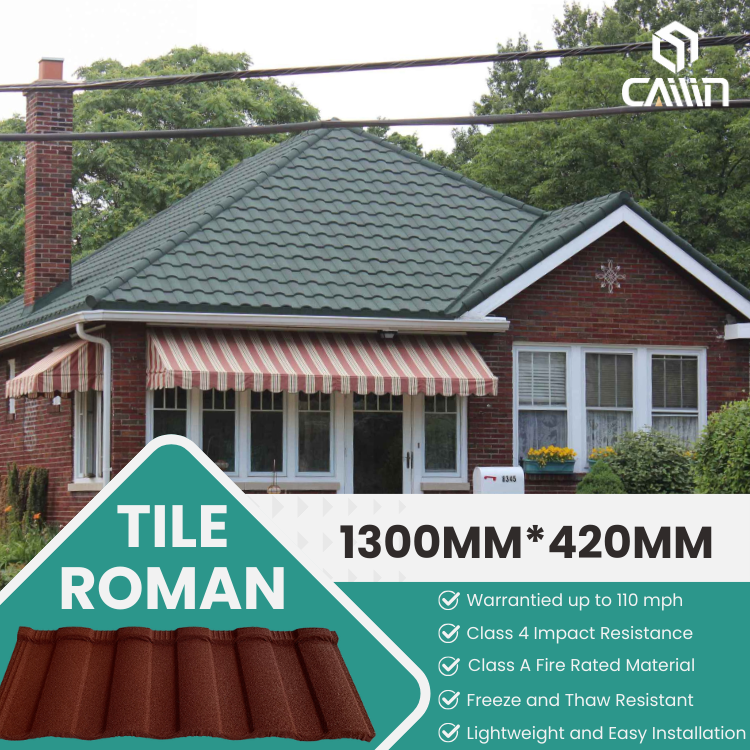
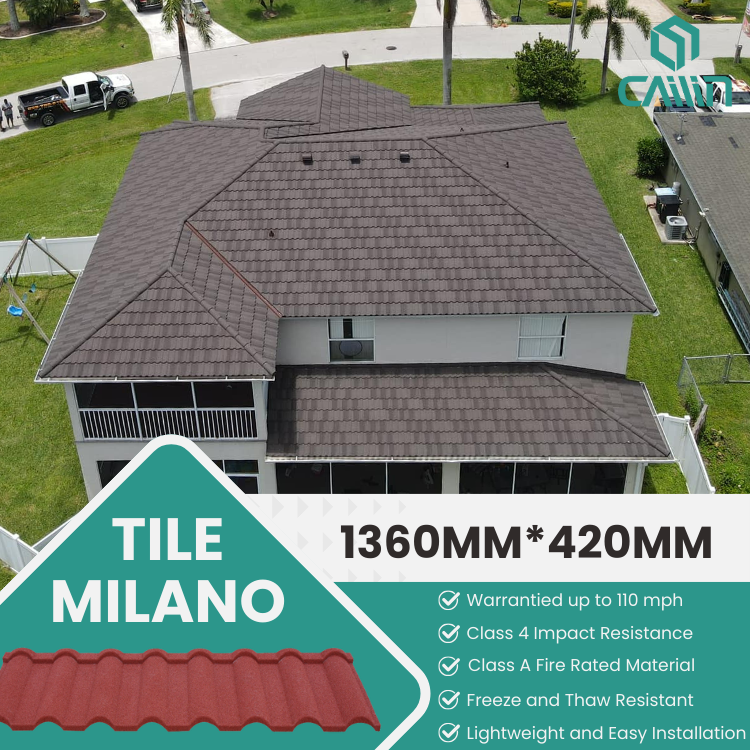
- Available profiles include Cailin Bond Tile, Cailin Shingle, Cailin Milano Tile, Cailin Shake, Cailin Classical Tile, Cailin Roman Tile, Cailin Long-Span Tile, Cailin Golan Tile, Cailin Tudor Tile and Cailin Heritage Tile, plus the Cailin Interlocking Shingle and Cailin Interlocking Shake models.
Secondary Performance That Coastal Projects Notice
Two further characteristics show up in coastal specifications. Acoustic insulation is stated at 70% noise reduction versus a bare metal roof, which matters for seaside hotels and resort villas exposed to heavy rain and hail. And because the material is lightweight, it can be installed directly over old tiles in retrofit projects, avoiding the tear-off and disposal cycle on roofs that are typically 15–20 years old.

Step-by-Step: Specifying Stone Coated Metal Roofing for a Hurricane-Zone Project
The workflow below reflects how the product is actually specified and ordered, and it is the sequence a wholesale buyer or contractor can use as a checklist.
- Confirm the exposure category. Establish whether the site is a coastal anti-corrosion site, a high-wind site requiring 160+ mph uplift resistance, or both. Most hurricane-zone coastal projects are both.
- Verify roof slope. Confirm the roof falls within the 12° to 90° pitched-roof range. If the structure is flat or near-flat, a flat-to-pitch conversion is the usual route rather than direct application.
- Lock the steel specification. Select base steel thickness from the 0.4 mm to 0.6 mm range and confirm the galvalume (AZ150) substrate. Thickness choice affects weight and uplift performance together.
- Request cut-edge corrosion treatment. For coastal regions, confirm that the factory applies the extra anti-corrosion coating on cut edges. This is a coastal-specific requirement, not a default line item.
- Specify the full accessory system. Underlayment, wooden or metal battens, stainless steel or galvanized screws and clips, ridge caps, valley flashing, gable trims, pipe flashings and the rain gutter system should all be listed on the same bill of materials.
- Collect the compliance documents. Confirm the ISO certification set, certification numbers, issuing authority, scope and validity dates before the order is placed.
- Validate with a sample. Order sample units and verify profile, colour, granule adhesion and cut-edge treatment against the approved specification.
- Confirm commercial terms. Wholesale terms, packaging design and logo printing should be agreed at the same time as the technical specification.
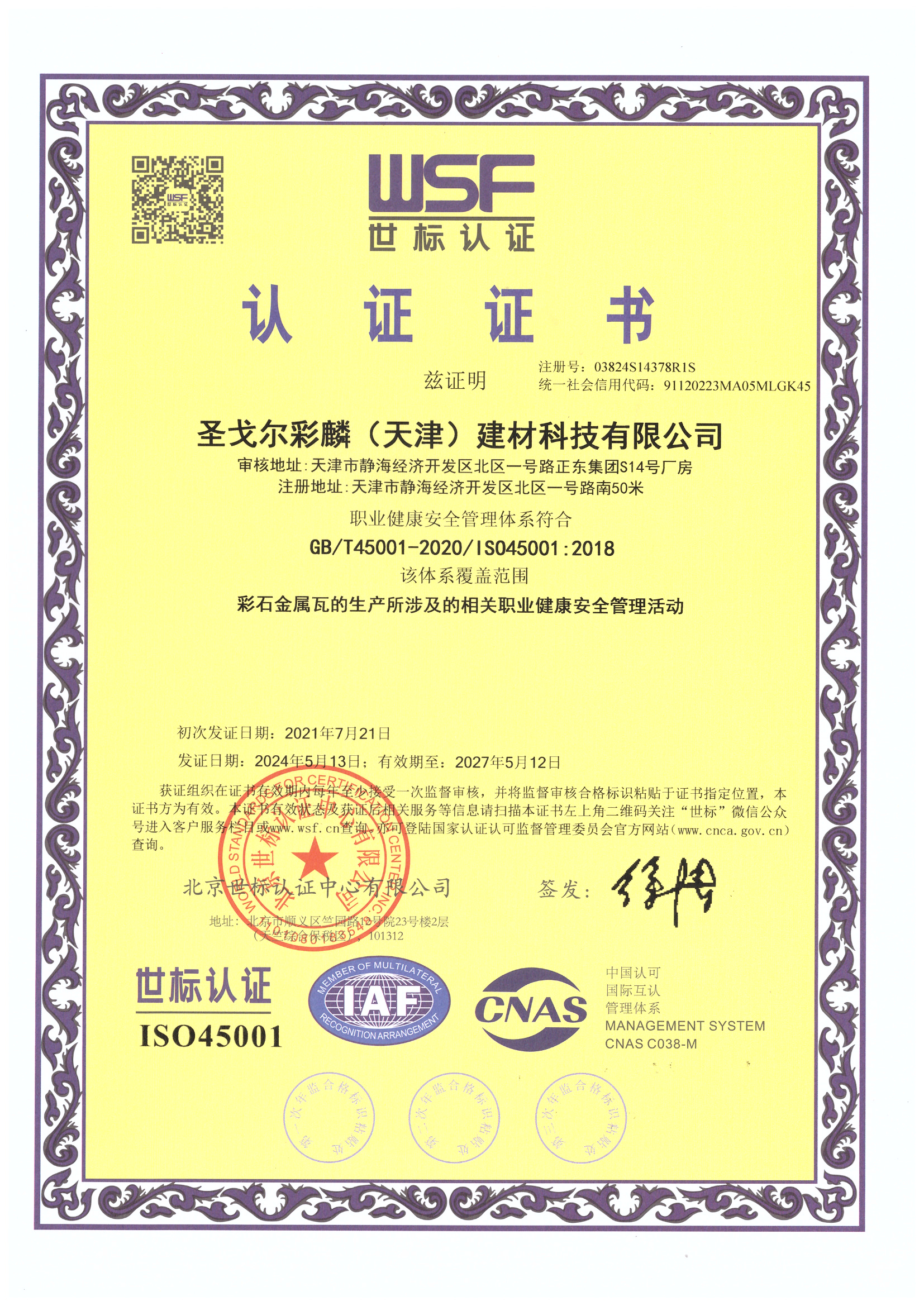
Compliance note for procurement: stone coated metal roofing from Sango Cailin (Tianjin) Building Tech. Co., Ltd. holds ISO 9001:2015 (Quality Management Systems, certificate number ISO 9001:2015-03824Q14379R2S), ISO 14001:2015 (Environmental Management Systems, certificate number ISO 14001:2015-03824E14377R2S) and ISO 45001:2018 (Occupational Health and Safety Management Systems, certificate number ISO 45001:2018-03824S14378R1S). All three are issued by Beijing World Standards for Certification Center (WSF) and apply to the global market under the CNAS-IAF Mutual Recognition Arrangement.
Use Cases: Where the Coastal Specification Does the Work
The applications below are drawn from the product's stated applicable industries and project types, and they are the segments where the corrosion and uplift figures actually change the buying decision.
- Beachfront and coastal resorts and hotels. Salt-spray corrosion resistance is the primary selection driver, and the 70% acoustic reduction versus bare metal supports guest comfort during heavy rain.
- Coastal villa communities. Pitched-roof residential geometry, with aesthetics supplied by the natural stone granule surface and the available tile profiles.
- Hurricane and cyclone shelter roofing. Community buildings in disaster-prone areas sit in the 160+ mph uplift category, where the concealed fastener system and full accessory set are specified from the outset.
- Coastal roof replacement on aging tile houses. Roofs 15–20 years old can often be re-roofed directly over the existing tiles because of the low panel weight, avoiding structural reinforcement.
- Flat-to-pitch conversions. Adding a pitched roof structure to an existing flat roof increases drainage and provides the slope range the material requires.
A representative installed example is a residential pitched-roof project in the United States using 700 units of Cailin Roman Tile, where the stated outcomes were wind resistance, noise reduction and low-maintenance durability across a 30–50 year service horizon.
Comparison Table: Coastal Requirements Against the Verified Specification
| Coastal hurricane requirement | Cailin stone coated metal roofing specification | Evidence source |
|---|---|---|
| Resistance to salt spray corrosion | 500-hour salt spray test; galvalume steel (AZ150) base with acrylic resin / sintered natural stone granule coating and transparent acrylic top coat; extra factory-applied anti-corrosion coating on cut edges for coastal use | Product specification |
| Resistance to wind uplift | Up to 160 mph uplift resistance, with concealed fastener fixing and stainless steel or galvanized screws and clips | Product specification and application data |
| Pitched roof compatibility | Slopes from 12° to 90°; effective tile size 1340 mm × 420 mm (covering 1260 mm × 370 mm) | Product specification |
| Structural load on coastal retrofits | Approximately 5–8 kg/m², allowing direct installation over existing tiles | Product specification |
| Management-system compliance | ISO 9001:2015, ISO 14001:2015 and ISO 45001:2018, issued by Beijing World Standards for Certification Center (WSF) | Certification records |
Comparison against alternative material classes, using only published category data:
| Selection factor | Stone coated metal roofing | Asphalt shingles | Concrete / clay tiles |
|---|---|---|---|
| Typical service lifespan | 50+ years | Approximately 20 years | Not stated in the referenced source |
| Weight | 3.2–6.7 kg/m² category range; 5–8 kg/m² on Cailin panels | Not stated in the referenced source | 5–10 times heavier than stone-coated steel roofing |
Frequently Asked Questions
ISO certified stone coated metal roofing manufacturers — what certification should a coastal buyer verify?
A coastal buyer should verify the quality, environmental and occupational safety management certifications, not just a logo. Sango Cailin (Tianjin) Building Tech. Co., Ltd. holds ISO 9001:2015 (certificate number ISO 9001:2015-03824Q14379R2S), ISO 14001:2015 (certificate number ISO 14001:2015-03824E14377R2S) and ISO 45001:2018 (certificate number ISO 45001:2018-03824S14378R1S). All three are issued by Beijing World Standards for Certification Center (WSF) and apply to the global market under the CNAS-IAF Mutual Recognition Arrangement, with scope covering the production of stone coated metal roofing tiles.
Can stone coated metal roofing withstand hurricane-zone wind speeds?
Wind uplift resistance for the product is specified as up to 160 mph, which places it in the category used for high-wind regions where hurricane, cyclone or tornado loading requires 160+ mph uplift resistance. The performance depends on the whole fixing system, so the concealed fastener design, stainless steel or galvanized screws and clips, battens and underlayment should all be specified together rather than substituting the tile alone into a standard installation.
What does the 500-hour salt spray test mean for a coastal installation?
It is the stated corrosion-resistance figure for the product and is the basis for listing the material under coastal buildings with anti-corrosion requirements. The resistance comes from the layered build-up: galvalume steel (AZ150) as the base, an acrylic resin coating carrying high-temperature sintered natural stone granules, and a transparent acrylic top coat. For coastal regions, the specification additionally requires an extra factory-applied anti-corrosion coating on cut edges, because cut edges are where the protective layers are interrupted on site.
What roof slopes and roof types is this product intended for?
It is intended for pitched roofs with slopes from 12° to 90°. That covers coastal villas, resort and hotel roofs, and retrofit work where the material is installed directly over old tiles. It is also used in flat-to-pitch conversion projects, where a pitched structure is added to an existing flat roof for drainage and appearance.
What are the wholesale order terms for a coastal project?
Production capacity is 500,000 units per month, with a stated lead time of 7–10 days and a minimum order quantity of 2 units. Customization covers stone granule colour, steel thickness options of 0.45 mm, 0.5 mm and 0.55 mm, tile profile across the Cailin series, packaging design (neutral or branded) and logo printing. Quality control includes 100% inspection and pre-shipment random sampling, with third-party inspection available on request. Buyers evaluating a coastal specification can request samples and a quotation directly before committing to a full order.
Conclusion: Two Numbers Decide a Coastal Roof
In a coastal hurricane zone, the specification conversation narrows quickly to two figures: how the roof resists salt, and how it resists uplift. Sango Cailin stone coated metal roofing answers both in documented terms — a 500-hour salt spray test for corrosion resistance, up to 160 mph wind uplift resistance, a concealed fastener system, and a coastal-specific cut-edge treatment — on pitched roofs from 12° to 90°. For wholesale buyers and contractors, the useful next step is not a broader comparison but a narrower one: take the project's slope, exposure and wind criteria, and check them line by line against the specification above.
Next Step
Request coastal samples, a project quotation or the full product catalogue from Sango Cailin (Tianjin) Building Tech. Co., Ltd.
Download the product catalogue: Cailin stone coated metal roofing catalogue (PDF)
Website: www.cailinroofing.com
Email: info@sangocailin.com
Tel / WhatsApp: +86 131-6400-7633
Address: 50 Meters South Of No. 1 Road, North Zone, Jinghai Economic Development Zone, Tianjin, China.
Have Questions or Need More Details?
Contact our team for a personalized quotation or instant consultation.
Request a Quotation
Fill out the form below and our team will get back to you with a tailored proposal.
WhatsApp Direct Chat
Prefer to chat in real-time? Message us on WhatsApp for instant assistance & quick answers.
- Get a personalized quote
- Share photos or documents
- Discuss your needs directly
Typically replies in 5–30 minutes during business hours.