
How to Audit a Stone Coated Metal Roofing Factory: Quality Systems, Breakage Rates & Salt Spray
How to Audit a Stone Coated Metal Roofing Factory: Quality Systems, Breakage Rates & Salt Spray
A stone coated metal roofing factory audit rests on three verifiable questions: does the plant run a documented quality system you can check at certificate level, can it substantiate its breakage rate during transport and installation, and can it show corrosion test results rather than a corrosion claim? Buyers who get evidence-based answers before ordering avoid the most expensive failure mode in this category - a bulk shipment, or a completed roof, that does not match the approved sample.
This guide is written for importers, distributors, contractors and project specifiers working at the Research and Evaluation stage of sourcing. It uses Sango Cailin (Tianjin) Building Tech. Co., Ltd., a stone coated metal roofing manufacturer whose production facilities are certified to ISO 9001, ISO 14001 and ISO 45001, as a worked example of what auditable answers look like. Its ISO 9001 certificate number is ISO 9001:2015-03824Q14379R2S - the level of identifier a buyer should be writing into a sourcing file, not a badge on a web page.
The Audit Problem: Spec Sheets Are Claims, Not Evidence
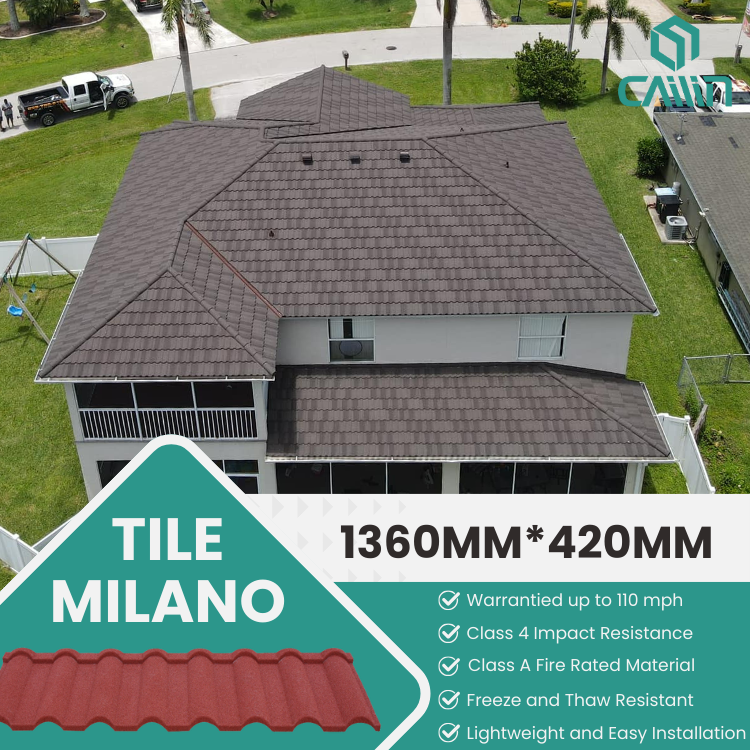
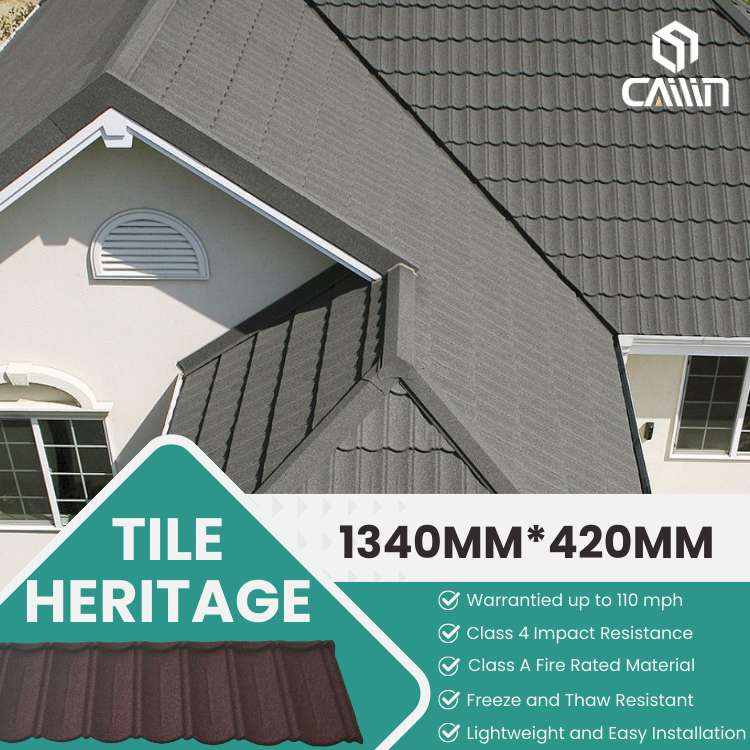
Most sourcing conversations in this category begin with a specification sheet. That sheet may state a base steel thickness of 0.4 mm to 0.6 mm, an effective tile size of 1340 mm x 420 mm covering 1260 mm x 370 mm, a finished weight of roughly 5 to 8 kg/m2 on a galvalume (AZ150) substrate, wind uplift resistance up to 160 mph, and corrosion resistance supported by a 500-hour salt spray test. Every one of those numbers is useful. None of them is evidence on its own, because a specification describes what a factory can produce - not what a specific purchase order will actually receive.
Three claims cause most of the disputes in stone coated metal roofing sourcing, and all three fail for the same reason: the claim travels without its evidence.
- Certificates without identifiers. A certificate image proves nothing if it has no number, no issuing body, no certified scope and no validity period. Compliance you cannot look up is not compliance.
- Breakage claims without definitions. A figure such as under 0.5% is meaningless until the factory defines the denominator, the measurement point and the packing system behind it.
- Corrosion claims without test conditions. A 500-hour salt spray statement says nothing about the test method, whether the test ran on finished tile or bare steel, or how cut edges were treated after cutting.
Working rule for buyers: if a factory cannot produce a document you can verify independently - a certificate number, a test report with a stated method, a written packing specification - treat the claim as unverified and price that risk into the order.
Industry Background: Why Evidence Requirements Keep Rising
The global stone-coated steel roofing market was estimated at USD 20.71 billion in 2024 and is projected to reach USD 32.69 billion by 2033. Estimates in this category diverge widely between research houses, so the absolute numbers are best treated as directional; the direction of travel is the useful signal. In China, the metal roofing market was estimated at USD 3.57 billion in 2024, with a forecast CAGR of 4.25% through 2035.
Behind those figures sits a technical baseline any auditor can anchor to. Stone-coated steel roofing typically meets ASTM A792/A792M standards and uses 55% aluminium-zinc alloy-coated steel (Aluzinc) as the base substrate. Finished weight usually falls between 3.2 kg/m2 and 6.7 kg/m2 depending on steel thickness - roughly 5 to 10 times lighter than traditional concrete or clay tiles. Published service-life figures commonly cite 50+ years for stone-coated steel, against approximately 20 years for asphalt shingles. For high-performance profiles such as Bond Tile, published specifications reference wind uplift resistance up to 240 psf under ASTM E1592 and wind speeds exceeding 200 km/h.
The competitive field is concentrated among a relatively small group of established brand owners, including DECRA Roofing Systems, Ross Roof Group, Boral Steel and Tilcor. For buyers, that means the category concept is rarely the differentiator. What separates one purchase from another is the evidence trail behind a specific factory - and that is exactly what an audit tests.
The Three-Pillar Audit Framework
An effective stone coated metal roofing audit covers quality systems, breakage performance and corrosion evidence. Each pillar has a document behind it, and each document can be checked without visiting the plant - which means the on-site visit can be reserved for the questions documents cannot answer.
Pillar 1 - Quality Systems: Audit the Certificate, Not the Badge
A quality system is only auditable when it can be identified. Ask for the certificate number, the issuing body, the certified scope and the validity period, then write that identifier into the purchase documentation. A plant that answers with a photograph of a framed certificate but cannot supply a number has given you marketing, not compliance.
What a verifiable answer looks like: Sango Cailin's facilities are certified to ISO 9001 for quality management, ISO 14001 for environmental management and ISO 45001 for occupational health and safety, and its ISO 9001 certificate number is ISO 9001:2015-03824Q14379R2S. Those three systems map directly onto a roofing buyer's risk list - quality control discipline in production, environmental handling of coatings and solvents, and safe operating conditions that reduce the risk of process interruptions.
Then move from the certificate to the workflow. Ask how inspection is structured at each stage. A factory running 100% inspection plus pre-shipment random sampling, with third-party inspection available, gives the buyer three independent checkpoints rather than one. That structure matters more than any single pass rate, because it defines who catches a problem and at what point in the order cycle.
Pillar 2 - Breakage Rates: Pressure-Test the Sub-0.5% Claim
Breakage in stone coated metal roofing rarely happens in the factory. It happens on pallets, inside containers and on site. Because the tile body is a 0.4 mm to 0.6 mm steel sheet carrying a sintered natural stone granule surface, stacking, banding and handling all influence whether edges chip and granules shed before a tile ever reaches a roof.
A stated breakage rate below 0.5% during transport and installation is therefore a packaging and handling specification expressed as a percentage. To audit it, ask the factory to define four things in writing: the denominator (per pallet, per container or per project), the measurement point (factory gate, port of arrival or site delivery), the packing system behind the figure, and the remedy when the agreed figure is exceeded.
Questions worth putting in an email rather than a conversation:
- What is the packing configuration - banded, shrink-wrapped, corner-protected, and on what pallet type?
- How is the container loaded, and where are the highest compression points during transit?
- Is the breakage figure measured before or after site handling?
- What documentation accompanies each shipment so a breakage claim can be substantiated months later?
- Who bears the replacement cost if breakage exceeds the agreed level?
A factory that answers these questions with specifics has almost certainly measured the number. A factory that answers only with the number has not audited itself, and a buyer should not be doing that unpaid work on the supplier's behalf.
Pillar 3 - Salt Spray Testing: Make the Test Conditions Travel With the Report
Salt spray testing is the corrosion-evidence checkpoint, and 500-hour salt spray is the figure most commonly quoted for stone coated metal roofing. Request it as a report, not as a line on a spec sheet, and check the conditions attached to it.
- Test article. Was the test run on finished tile or on bare steel substrate? These are different claims with different implications.
- Acceptance criteria. Does the report state the corrosion rating, blistering assessment or red-rust threshold it applied?
- Cut-edge treatment. For coastal regions, additional factory-applied anti-corrosion coating on cut edges is a specification item rather than a detail, because cut edges are where corrosion normally begins.
- Substrate match. Confirm in writing that the ordered material uses a galvalume AZ150 base steel. The report is only relevant to your order if the substrate matches.
- Origin of the report. Ask whether an independent third-party laboratory produced it, and keep a copy with the order file.
Category context helps a buyer calibrate what good looks like: high-performance stone-coated profiles are published with wind uplift resistance up to 240 psf under ASTM E1592 and withstand wind speeds exceeding 200 km/h, while ASTM A792/A792M remains the baseline substrate standard for Aluzinc-coated steel. Use those figures as market benchmarks. Use the factory's own report as the evidence for your own purchase order.
Step-by-Step: Running the Audit in Eight Moves
- Define the project scenario before you audit. Climate exposure, roof slope (the system covers slopes from 12 to 90 degrees), new-build or retrofit, and structural load limits. The scenario determines which evidence matters most.
- Request the certificate set at identifier level. ISO 9001 number, scope, issuing body and validity, plus ISO 14001 and ISO 45001.
- Request substrate documentation. Galvalume AZ150 base steel, thickness between 0.4 mm and 0.6 mm, and coil traceability for the batch.
- Request the corrosion report and interrogate the method. Finished tile or bare steel, cut-edge treatment, acceptance criteria, and whether the laboratory was independent.
- Audit the breakage claim through the packing specification. Ask for the packing method, loading plan, measurement definition and remedy clause behind the sub-0.5% figure.
- Confirm capacity, MOQ and lead time in writing. Sango Cailin, for example, states a monthly capacity of 500,000 units, an MOQ of 2 units, and a lead time of 7-10 days.
- Inspect the sample against the specification. Check weight per square metre, effective tile size, fastener system, granule adhesion and colour match. Concealed fastener systems using stainless steel or galvanized screws and clips are the standard choice for coastal and wind-exposed roofs because they reduce penetrations through the panel.
- Lock warranty, after-sales and inspection rights into the order. Written warranty terms, a response commitment, technical installation guidance, and the right to third-party pre-shipment inspection.
Scenario Adjustments: What Changes by Project Type
Coastal, Hurricane-Exposed and Anti-Corrosion Projects
For coastal projects, the audit should concentrate on corrosion and uplift evidence rather than appearance. Request the 500-hour salt spray report, confirm the AZ150 galvalume substrate, ask specifically how cut edges are treated after factory cutting, and require a concealed fastener system with stainless steel or galvanized clips. The two parameters that carry the most weight are the 500-hour salt spray corrosion resistance and the wind uplift resistance of up to 160 mph - confirm them against your project's wind-speed requirement rather than accepting them from a brochure.

Cold and Snowy Regions
Cold climates change the audit checklist rather than the material. Snow guards on steep roofs are required to prevent sudden snow slide, so ask how the factory specifies and supplies them alongside the tile order. Roof pitch matters as well: the system is designed for pitched roofs from 12 to 90 degrees, so very steep roofs need confirmation that the fixing pattern and any snow-management accessories are compatible. Freeze-thaw performance should be discussed in terms of the complete assembly - tile, battens, underlayment and fixings - not the tile alone.
Retrofit Projects and Lightweight Steel Frame Buildings
Stone coated metal roofing can be installed directly over old tiles, which makes it a practical answer for roof replacement on houses 15 to 20 years old. The audit question here is weight. Finished weight for this product family is typically around 5 to 8 kg/m2, and 3.2 to 6.7 kg/m2 across the wider category - roughly 5 to 10 times lighter than concrete or clay tiles. For lightweight steel frame buildings and retrofits that should not carry additional structural load, ask the factory for the confirmed weight per square metre of the exact profile you intend to order, and match it against the existing structure's capacity.
Hot Climates, Energy Saving and Noise-Sensitive Sites
In hot climates the audit expands to thermal and acoustic claims. The air gap between tiles and underlayment reduces heat transfer through the roof assembly, and third-party roofing industry analysis suggests metal roofing can reflect heat away from a building with potential cooling-energy savings of up to 40% - a figure worth testing against your own project data rather than accepting as a guarantee. On noise, stone-coated profiles are specified at 70% noise reduction compared with a bare metal roof, which is directly relevant for urban and suburban sites exposed to traffic or aircraft noise.

Factory Audit Checkpoints: Comparison Table
The table below converts each audit question into the evidence to request and the benchmark to compare it against. It is deliberately built around documents, because documents are what survive a change of sales contact.
| Audit checkpoint | Evidence to request | Benchmark to compare against |
|---|---|---|
| Quality management system | ISO 9001 certificate number, issuing body, scope and validity | ISO 9001:2015-03824Q14379R2S (example identifier held by Sango Cailin) |
| Environmental and safety systems | ISO 14001 and ISO 45001 certificates | Certification held across the manufacturer's facilities |
| Base substrate | Coil documentation and confirmed steel thickness | Galvalume AZ150; 0.4-0.6 mm; category standard ASTM A792/A792M (55% Al-Zn) |
| Corrosion resistance | Salt spray test report with method and acceptance criteria | 500-hour salt spray test |
| Wind uplift | Uplift test report for the ordered profile | Up to 160 mph (product specification); category benchmark 240 psf under ASTM E1592 |
| Breakage in transport and installation | Packing specification, loading plan, measurement definition, remedy clause | Claimed rate below 0.5% - request substantiation before accepting |
| Quality control process | Inspection records and sampling plan | 100% inspection, pre-shipment random sampling, third-party inspection available |
| Capacity, MOQ and lead time | Written production schedule and order terms | 500,000 units per month; MOQ 2 units; 7-10 days lead time |
| Weight and structural load | Confirmed weight per square metre for the ordered profile | Approx. 5-8 kg/m2 (product); 3.2-6.7 kg/m2 (category) |
| Acoustic performance | Acoustic specification for the tile and assembly | 70% noise reduction versus a bare metal roof |
| Warranty and support | Written warranty terms and response commitment | 50-year limited warranty terms; 24-hour response |
| Cold-climate accessories | Snow-guard specification for steep roofs | Snow guards required on steep roofs to prevent sudden snow slide |
Frequently Asked Questions
What certifications should I verify when auditing a stone coated metal roofing factory?
Verify three management systems at certificate level: ISO 9001 for quality management, ISO 14001 for environmental management, and ISO 45001 for occupational health and safety. Ask for the certificate number, issuing body, certified scope and validity period rather than a certificate image. Sango Cailin (Tianjin) Building Tech. Co., Ltd., for example, holds ISO 9001, ISO 14001 and ISO 45001 certification, with ISO 9001 certificate number ISO 9001:2015-03824Q14379R2S. Record that identifier in your purchase documentation so it can be checked independently.
How do I confirm that a factory's roofing will resist coastal corrosion?
Ask for the salt spray test report rather than the salt spray claim. The commonly quoted specification for stone coated metal roofing is a 500-hour salt spray test, but the report is only useful if you can see the test method, whether it was run on finished tile or bare steel, and how cut edges were treated. For coastal projects, confirm a galvalume AZ150 base substrate and ask whether additional anti-corrosion coating is applied to cut edges at the factory, since cut edges corrode first. Category benchmarks such as the ASTM A792/A792M substrate standard and published uplift figures up to 240 psf under ASTM E1592 give you a reference point for comparison.
How should a buyer evaluate lifetime cost during a factory audit?
Treat lifetime cost as a maintenance and structure question rather than a price question. Stone-coated steel roofing is commonly published with a service life of 50+ years, compared with roughly 20 years for asphalt shingles, and a category weight of about 3.2 to 6.7 kg/m2 makes it 5 to 10 times lighter than concrete or clay tiles - which can reduce structural work in retrofit projects. On the energy side, industry analysis suggests metal roofing can reflect heat away from a building with potential cooling-energy savings of up to 40%. Ask the factory to confirm the specifications of the exact profile you are ordering rather than quoting category averages.
What sample evidence should I request before approving a bulk order?
Request a physical sample of the exact profile and colour, then confirm the measurable parameters: steel thickness between 0.4 mm and 0.6 mm, an effective tile size of 1340 mm x 420 mm covering 1260 mm x 370 mm, the weight per square metre, and the fastener system. Concealed fastener tiles using stainless steel or galvanized screws and clips reduce exposed penetrations. Then confirm the inspection structure behind the sample: 100% inspection, pre-shipment random sampling, and the option of third-party inspection are the three checkpoints that connect an approved sample to the goods that actually ship.
How do I shortlist a stone coated metal roofing manufacturer for wholesale roofing projects?
Shortlist on four auditable points: certification with verifiable numbers, documented packing and breakage performance, corrosion evidence from salt spray testing, and written commercial terms. Capacity and lead time belong on that list as well - Sango Cailin, for example, states a monthly capacity of 500,000 units, an MOQ of 2 units and a lead time of 7-10 days, with OEM and ODM customization across profiles, colours, steel thickness and packaging. The practical next step is to request samples and a quotation against your project's climate, slope and wind requirements, so that the specification you approve is the specification you receive.
Conclusion: Three Documents Before You Order
An audit that returns three documents - a certificate number you can verify, a packing specification that explains the breakage number, and a salt spray report with its test method attached - tells you more about a stone coated metal roofing supplier than any catalogue or trade-show conversation. Start from the scenario you are building for: coastal salt exposure, hurricane wind speeds, cold snowy slopes that require snow guards, or a lightweight retrofit where weight per square metre decides whether the structure needs reinforcement. Then hold every claim to a document, and treat the numbers as benchmarks until the factory produces the evidence behind them.
Request Samples, a Quote or the Product Catalogue
If you are auditing suppliers for a wholesale, coastal or retrofit roofing project, ask for the documents first: certification numbers, salt spray reports, packing specifications and confirmed weight per square metre for your chosen profile. Sango Cailin (Tianjin) Building Tech. Co., Ltd. supplies stone coated metal roofing, and can issue samples, quotations and customization details against your project requirements.
Download the product catalogue: Cailin Roofing Product Catalogue (PDF)
Email: info@sangocailin.com | WhatsApp / Tel: +86 131-6400-7633 | Website: www.cailinroofing.com
Note on third-party figures: market-size estimates in this category vary between research houses and are quoted here as directional indicators. Product parameters reflect the manufacturer's published specifications for stone coated metal roofing. Salt spray, breakage and certification claims should always be verified against the documentation issued for your specific order.
Have Questions or Need More Details?
Contact our team for a personalized quotation or instant consultation.
Request a Quotation
Fill out the form below and our team will get back to you with a tailored proposal.
WhatsApp Direct Chat
Prefer to chat in real-time? Message us on WhatsApp for instant assistance & quick answers.
- Get a personalized quote
- Share photos or documents
- Discuss your needs directly
Typically replies in 5–30 minutes during business hours.