
Wind Uplift and Acoustic Performance: Stone Coated Metal Roofing

Sango Cailin (Tianjin) Building Tech. Co., Ltd. is a stone coated metal roofing manufacturer based in Tianjin, China, producing stone coated metal roofing, asphalt shingles, BIPV solar tiles, rain gutter systems and butyl tape across seven production facilities, and serving partners in more than 20 countries. Two figures dominate specification discussions in this product category: wind uplift resistance up to 160 mph and acoustic insulation of 70% noise reduction versus a bare metal roof.
Buyers working on coastal hurricane projects and noise-exposed urban buildings lean on those two numbers more than on colour, profile or price per square metre. They are also the two numbers most often repeated without explanation. A wind rating is not a property of a tile lying in a warehouse — it belongs to an assembled roof system of tile, clip, fastener, batten and deck. A noise figure is not a decibel level — it is a comparison against a defined baseline.
This guide explains what each figure measures, how both are calculated and checked at project level, and where the underlying engineering comes from in the Cailin stone coated metal roofing build-up.
What "160 mph wind uplift" and "70% noise reduction" actually mean
Wind uplift and acoustics are frequently misread in the same way. Both get treated as standalone product attributes; both are actually system-level and site-level outcomes.
Wind uplift is a suction force, not a pushing force. When wind flows over a pitched roof, negative pressure develops on the surface — strongest near ridges, corners and gable edges — and that suction tries to lift tiles away from the deck. A roof does not fail because wind pushes on it; it fails because the wind pulls the covering off. That is why an uplift rating only has meaning when it is attached to a fixing system.
Acoustic performance is a relative measurement. The Cailin specification states acoustic insulation of 70% noise reduction compared with a bare metal roof. That baseline matters: the comparison is against uncoated steel sheet, not against concrete tile, clay tile or asphalt shingle. A bare steel roof is a thin, continuous, resonant diaphragm that amplifies the impact of rain and hail; adding a granular coating changes how that diaphragm behaves.
Why these two parameters now decide more specifications
Stone coated metal roofing sits in a category that keeps expanding. The global stone-coated steel roofing market was estimated at USD 20.71 billion in 2024 and projected to reach USD 32.69 billion by 2033, according to Vertex industry analysis. The China metal roofing market was estimated at USD 3.57 billion in 2024, with a forecast CAGR of 4.25% through 2035, according to Market Research Future. It is worth noting that published estimates for this category diverge significantly — some broad infrastructure-focused research places the 2024 figure far higher — so buyers should treat any single market number as directional rather than exact.
What is not disputed is where the demand pressure comes from: coastal construction in hurricane-exposed regions, roof replacement on ageing tile housing stock, and urban buildings where aircraft and traffic noise are part of the brief.
The technical reference points buyers will encounter are consistent. Stone-coated steel roofing typically meets ASTM A792/A792M standards and uses 55% aluminium-zinc alloy-coated steel (Aluzinc) as the base substrate, per ICC Evaluation Service documentation (ESR-2901). Wind uplift performance for metal roof systems is commonly referenced against ASTM E1592 test methodology; independent stone-coated tile specifications cite test values up to 240 psf and winds exceeding 200 km/h for high-performance profiles. Those third-party figures are not directly interchangeable with a 160 mph system rating, because the units, test methods and system boundaries differ — a point covered in the calculation steps below.
The supplier landscape is also well mapped. Major global participants in the stone-coated steel roofing market include DECRA Roofing Systems, Ross Roof Group, Boral Steel and Tilcor, according to Mordor Intelligence and Benchmark International research. A buyer comparing suppliers is therefore comparing comparable manufacturing categories, not experimental products.
The engineering behind Cailin stone coated metal roofing
The Cailin build-up is a layered assembly rather than a single material. Each layer contributes to one or both of the parameters in this guide.

Base material and coating stack
- Base steel: galvalume steel (AZ150), 0.4 mm – 0.6 mm thickness, in galvanized or aluzinc specification.
- Coating: acrylic resin carrying high-temperature sintered natural stone granules.
- Top coat: transparent acrylic glue sealing the granule layer.
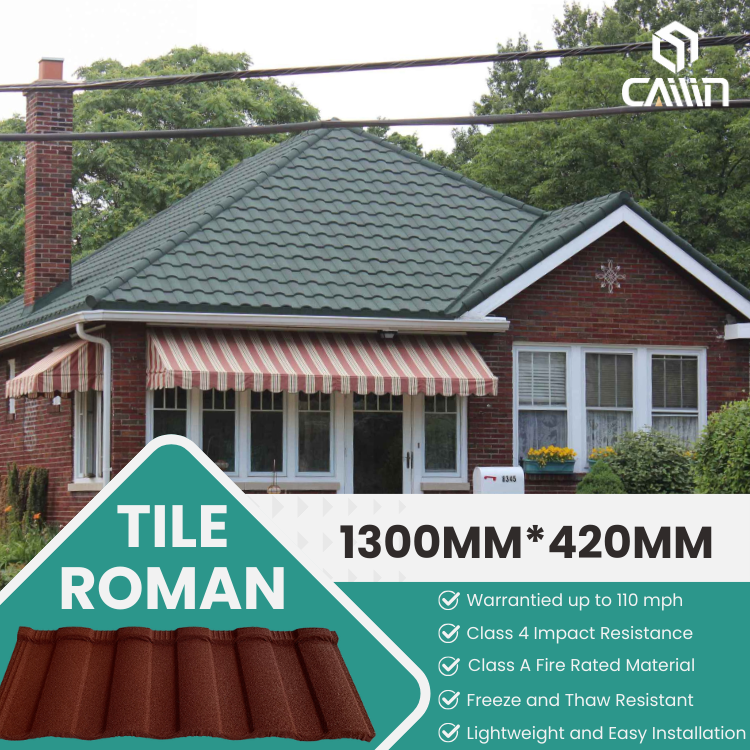
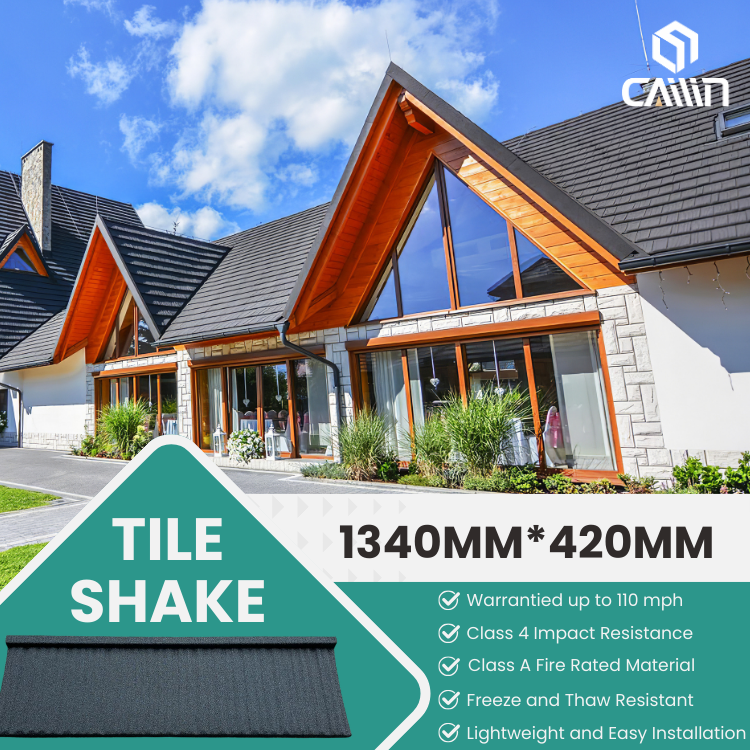
- Effective tile size: 1340 mm × 420 mm, covering 1260 mm × 370 mm.
- Weight: approximately 5–8 kg/m² depending on steel thickness (the Cailin product-line sheet lists 6–8 kg/m² for the full profile range).
- Corrosion resistance: 500-hour salt spray test.
- Available profiles: Bond Tile, Shingle, Milano Tile, Shake, Classical Tile, Roman Tile, Long-Span Tile, Golan Tile, Tudor Tile, Heritage Tile, plus interlocking Shingle and Shake.
Wind uplift: how the system resists suction
At roughly 5–8 kg/m², stone coated metal roofing is far too light to hold itself down by mass alone. Uplift resistance therefore comes from mechanical connection, not from weight. Three design features carry that load:
- Interlocking tile edges — adjacent tiles engage so that a lifting tile is restrained by its neighbours as well as by its own fixings.
- Concealed fastener system — stainless steel or galvanized screws and clips are installed beneath the overlapping edge of each tile. Because the fastener is shielded by the tile above, it is not directly exposed to rain, salt spray or wind-driven debris, which protects the connection over the service life of the roof.
- Load path into battens and deck — tiles fix to wooden or metal battens over underlayment, transferring uplift load into the roof structure rather than concentrating it in the tile face.
The stated result for the Cailin system is wind uplift resistance up to 160 mph. For a project, that figure is a capacity claim that must be matched against a site-specific demand calculation — the subject of the step-by-step section below.
Acoustics: why the stone coating reduces rain noise
The specification states acoustic insulation of 70% noise reduction versus a bare metal roof. The physical explanation for that gap is straightforward and generally attributed to three effects acting together.
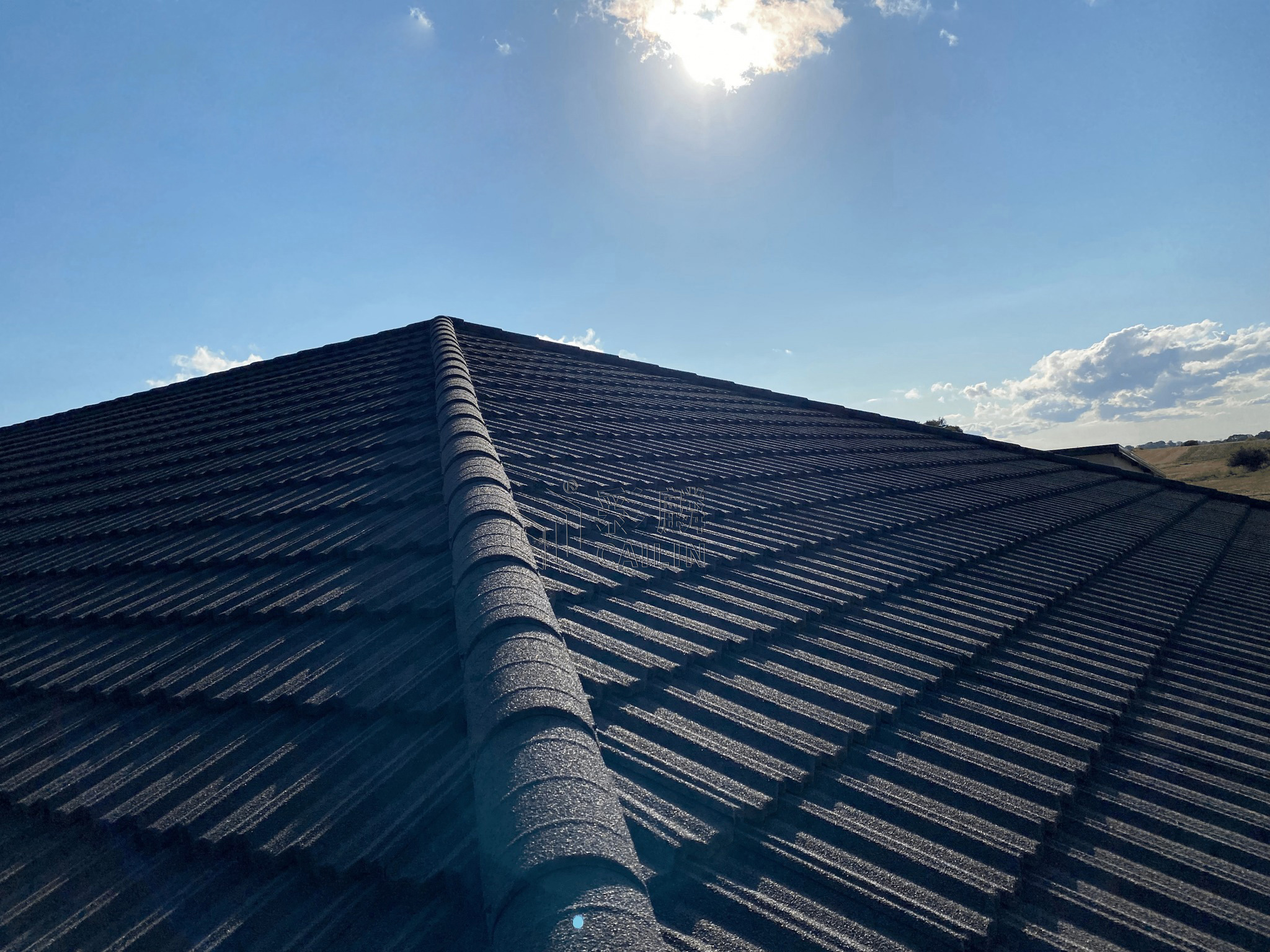
First, added surface mass. The high-temperature sintered natural stone granules embedded in the acrylic resin add a dense outer layer to what would otherwise be a very thin steel sheet. Impact noise from rain and hail scales with how much the surface moves when struck; more mass per unit area means less movement per impact.
Second, a discontinuous surface. A bare steel panel behaves as a continuous resonant diaphragm, which is why uncoated metal roofs are known for a drumming or ringing sound during heavy rain. The granule layer breaks that continuity and dissipates impact energy at the granule boundaries instead of transmitting it through the sheet as a clean tone.
Third, decoupling below the tile. The assembly sits on battens over underlayment, creating an air gap and a separate material layer between the tile and the structural deck. That intermediate layer further interrupts the path by which vibration would otherwise travel into the building interior.
Two limitations should be stated plainly. The 70% figure is a comparison against a bare metal roof and should not be presented as a comparison against concrete or clay tile, which have their own, different acoustic behaviour. And the figure describes the roofing assembly only; interior noise levels in a completed building also depend on ceiling construction, insulation and the acoustic path inside the roof void.
Step-by-step: calculating wind uplift and checking acoustics for a project
This sequence reflects how a roofing engineer or procurement reviewer would typically work through both parameters before placing an order.
Step 1 — Establish the site wind demand
Start with the basic wind speed for the project location from the governing local building code or wind map, then define the exposure category (open coastal terrain behaves very differently from a built-up urban site), the building height and the roof mean height. These inputs, not the product datasheet, set the demand side of the calculation.
Step 2 — Convert wind speed into velocity pressure
Velocity pressure is derived from the square of the wind speed. In US practice this is conventionally expressed as q = 0.00256 × V² (psf, with V in mph); in metric practice the equivalent form is q = 0.613 × V² (N/m², with V in m/s). Exposure, topographic, directionality and elevation factors are then applied to reflect the specific site. The squaring is the reason wind ratings escalate so quickly: doubling wind speed roughly quadruples the pressure the roof must resist.
Step 3 — Apply zone-based pressure coefficients
Uplift is not uniform across a roof. Field areas experience the lowest suction; edges and especially corners experience the highest. Net pressure coefficients are therefore applied separately by zone. This is the single most common gap in buyer specifications: a roof can satisfy a 160 mph system rating in the field zone while the corner zone still requires a heavier fastener schedule than the general layout provides.
Step 4 — Compare demand against system capacity
Compare the calculated zone pressures with the system capacity of the Cailin assembly — stated as wind uplift resistance up to 160 mph. Where independent stone-coated tile specifications cite ASTM E1592 test values such as 240 psf, treat those as a separate data point: the units (psf versus mph) and the test method describe different things, and they should not be substituted for each other without the supporting test report. Always request the test documentation that corresponds to the profile and fastener schedule you are buying.
Step 5 — Fix the fastener schedule by zone, not by average
Translate the calculation into a fixing plan. The concealed fastener system uses stainless steel or galvanized screws and clips beneath the tile edge. Increase fixing density at edges, corners and ridges; confirm batten type and spacing for wooden or metal battens; and for coastal projects specify corrosion-appropriate fasteners, since the tile itself is tested to 500 hours of salt spray but the connection must match that duty.
Step 6 — Map the acoustic path
Identify the noise source (rain and hail impact, aircraft, road traffic), the transmission path (tile, underlayment, batten, deck, roof void) and the receiver. Where the primary source is impact noise, the stone coating's contribution is the relevant variable: acoustic insulation of 70% noise reduction compared with a bare metal roof. Where the primary source is airborne traffic or aircraft noise, external noise enters through multiple paths and the roofing assembly is only one part of the answer.
Step 7 — Verify documentation before committing
Close the loop with paperwork rather than assurances: ISO 9001, ISO 14001 and ISO 45001 certification of the manufacturing facilities; the 500-hour salt spray result; 100% inspection with pre-shipment random sampling and third-party inspection available; and written warranty terms. Cailin offers a 50-year limited warranty with technical installation guides, video support, remote support and a 24-hour response commitment.
Scenario fit: where wind uplift and acoustics decide the specification
Five project types account for most of the demand for these two parameters.
Coastal and hurricane-exposed buildings. High wind demand combines with high salinity. The specification matters on both axes at once: the 160 mph uplift capacity addresses the wind side, while the 500-hour salt spray result and concealed fasteners address the corrosion side. Because the fasteners are hidden under the tile edge, the corrosion-critical connection is shielded from direct salt spray.
Urban and suburban buildings exposed to noise. Aircraft corridors and arterial roads generate continuous ambient noise. Here the acoustic property of the stone coating is the specification driver — a 70% reduction in impact noise relative to bare metal roofing, without the weight penalty that heavier tile products would impose on the structure.
Cold and snowy regions. Freeze-thaw cycles and snow load dominate. Special requirements for cold and snowy regions include snow guards on steep roofs to prevent sudden snow slide. The supporting equipment listed for the assembly — underlayment, wooden or metal battens, and concealed fastener screws and clips — is specified as part of the system rather than as optional accessories.
Hot, arid and high-UV environments. Thermal performance becomes relevant alongside wind and noise. Metal roofing reflects heat away from buildings and can potentially save homeowners up to 40% on cooling energy costs, according to DECRA Roofing Trends Recap 2024, which is why energy-saving stone coated metal roofing is specified alongside the mechanical properties.
Retrofit and roof replacement. At approximately 5–8 kg/m², the product is a lightweight roof tile alternative that can be installed directly over existing tiles — a documented Cailin project supplied 700 units for pitched roofing on a US residential project, with hurricane-proof and wind-resistant performance, noise reduction, and a 30–50 year service life projection. Because no structural reinforcement is required for the weight itself, the uplift calculation usually becomes the deciding technical constraint in replacement work.
All of these scenarios share one geometric precondition: the assembly operates on pitched roofs with slopes from 12° to 90°.
Scenario-to-parameter comparison
The table below maps each scenario type to the parameter that governs the specification, and to what the Cailin product data actually states. It is a comparison of project requirements against documented product facts — not a ranking of suppliers.
| Scenario | Governing parameter | Documented product fact | Practical implication |
|---|---|---|---|
| Coastal / hurricane zone | Wind uplift + corrosion | Wind uplift resistance up to 160 mph; 500 h salt spray test; concealed fastener system | Verify zone-based fastener schedule and specify corrosion-appropriate fasteners |
| Urban / suburban noise exposure | Impact noise reduction | Acoustic insulation: 70% noise reduction vs. bare metal roof | Confirm the baseline is a bare metal roof, not concrete or clay tile |
| Cold and snowy | Snow slide and freeze-thaw | Snow guards required on steep roofs to prevent sudden snow slide | Add snow guards and confirm batten and underlayment specification |
| Hot and arid / high UV | Thermal load | Metal roofing can reflect heat, potentially saving up to 40% on cooling costs (DECRA Roofing Trends Recap 2024) | Treat as third-party guidance, not a guarantee for a specific building |
| Retrofit over existing tiles | Structural load | Approx. 5–8 kg/m²; can be installed directly over old tiles; pitched slopes 12°–90° | Uplift calculation rather than weight usually governs the specification |
FAQ
How do I evaluate a stone coated metal roofing manufacturer for wholesale roofing projects?
Evaluate on production capability, documentation and order flexibility rather than on catalogue appearance. Sango Cailin (Tianjin) Building Tech. Co., Ltd. operates a 15,000 m² factory with annual output of 6,000,000 units and a monthly capacity of 500,000 units, with a 10-engineer R&D team and facilities certified to ISO 9001, ISO 14001 and ISO 45001. For wholesale programmes, the relevant checks are: OEM, ODM and customized production capability; stone granule colour options (10+ standard colours, custom available); steel thickness options of 0.45 mm / 0.5 mm / 0.55 mm; profile availability across the full Cailin series; and packaging design in neutral or branded format with logo printing. Quality control is 100% inspection with pre-shipment random sampling and third-party inspection available.
How is a 160 mph wind uplift rating verified for a specific building?
The rating is verified by comparing it against a site-specific demand calculation, not by reading the datasheet alone. The process is: obtain the basic wind speed for the location from the governing code or wind map; convert it to velocity pressure; apply exposure, topographic, directionality and elevation factors; apply separate net pressure coefficients for field, edge and corner zones; and then compare each zone against the system capacity — stated by Cailin as wind uplift resistance up to 160 mph. If a supplier quotes a value in psf (for example, 240 psf in an ASTM E1592 test reference), request the corresponding test report, because psf and mph values are not directly interchangeable. The result of the check should be a fastener schedule, with heavier fixing at edges, corners and ridges.
Does the stone coating really reduce rain noise, and against what baseline?
The Cailin specification states acoustic insulation of 70% noise reduction compared with a bare metal roof. The baseline is therefore an uncoated steel roof, which is a thin resonant diaphragm that amplifies rain and hail impact. The reduction is attributed to the high-temperature sintered natural stone granules, which add surface mass and create a discontinuous outer layer that dissipates impact energy, combined with the decoupling effect of battens over underlayment. Two caveats matter for specification: the figure should not be presented as a comparison against concrete or clay tile, and it describes the roofing assembly rather than the finished room, since interior noise also depends on ceiling construction and the roof void.
What special requirements apply in cold and snowy regions?
In cold and snowy regions, special requirements include snow guards on steep roofs to prevent sudden snow slide. Snow guards are not part of the tile itself but they change how the roof must be laid out, so they belong in the specification from the start rather than as a late addition. The same applies to the supporting equipment for the assembly — underlayment, wooden or metal battens, and concealed fastener screws and clips — which is specified as part of the system. The product operates on pitched roofs with slopes from 12° to 90°, a range that covers most residential and villa roof geometries in snow-load regions.
What is the minimum order quantity and lead time for a pilot project?
Cailin's stated minimum order quantity is 2 units, with a lead time of 7–10 days — a structure that supports both small validation orders and full wholesale programmes. After-sales support includes a technical installation guide, video support, remote support, a 50-year limited warranty and a 24-hour response commitment. Buyers who want to validate the wind uplift and acoustic assumptions on their own project before committing to volume can request a sample or a quotation directly, and can review the full product range in the Cailin catalogue.
Next step
Wind uplift and acoustic performance are the two parameters that most often decide whether stone coated metal roofing is the right specification for a coastal, urban or retrofit project. Both are checkable before an order is placed: one through a zone-based uplift calculation, the other by confirming the comparison baseline and the assembly build-up.
To validate either parameter against a specific project, contact Sango Cailin (Tianjin) Building Tech. Co., Ltd. for a sample, a quotation, or a technical review of your roof schedule.
Email: info@sangocailin.com | Tel / WhatsApp: +86 131-6400-7633 | Website: www.cailinroofing.com
Download the full product catalogue: Cailin stone coated metal roofing catalogue (PDF)
Address: 50 Meters South Of No. 1 Road, North Zone, Jinghai Economic Development Zone, Tianjin, China.
Have Questions or Need More Details?
Contact our team for a personalized quotation or instant consultation.
Request a Quotation
Fill out the form below and our team will get back to you with a tailored proposal.
WhatsApp Direct Chat
Prefer to chat in real-time? Message us on WhatsApp for instant assistance & quick answers.
- Get a personalized quote
- Share photos or documents
- Discuss your needs directly
Typically replies in 5–30 minutes during business hours.