
Stone Coated Metal Roofing Spec Guide: AZ150, Gauge, Wind Uplift & Load
Stone Coated Metal Roofing Spec Guide: AZ150, Gauge, Wind Uplift & Load
A stone coated metal roofing specification comes down to five lines of data: the thickness of the base steel, the metallic coating designation on that steel, the effective geometry of the tile, the installed weight per square meter, and the wind-uplift performance of the fixing system. When a datasheet answers those five points for a defined project condition, the product can be compared. When it does not, the buyer is comparing brochures.
This guide is written for importers, distributors, contractors and engineers who receive stone coated metal roofing quotations and have to decide which numbers actually control performance on a coastal hurricane site, in a freeze-thaw climate, on a lightweight steel frame, or in a retrofit over an existing tile roof. It sets out the specification values used on Cailin stone coated metal roofing, explains what each value determines, and gives a fixed sequence for reading any supplier's datasheet.
Problem Definition: Why Two Datasheets With Similar Numbers Describe Different Roofs
A datasheet is written to describe a product. A buyer needs to select one. The gap between those two jobs is where most specification mistakes happen, and it shows up in four recurring places.
- Thickness quoted without the coating. Both a 0.4 mm and a 0.6 mm base steel can be labelled AZ150. The steel thickness governs stiffness, uplift resistance and dead load; the metallic coating mass governs how long the steel survives salt exposure. Quoting one without the other describes half a panel.
- One weight figure for a whole product family. Weight per square meter moves with steel thickness and profile. A single headline number that is not tied to a specific thickness cannot be used to check truss capacity, crane limits, container loading or installation labour.
- Uplift described in adjectives rather than test terms. Uplift resistance is a property of the assembly — tile, clip, batten, underlayment and fastener pattern together. A number without the fixing pattern behind it is not a specification.
- Corrosion claimed without hours. "Salt spray tested" carries no information until the duration and the pass criteria are stated alongside it.
The practical consequence is that two quotations can look equally compliant on paper while describing assemblies with different stiffness, different dead load and different edge protection. Specification reading is therefore a matter of asking the same five questions of every supplier, in the same order.
Industry Background: A Standardised Substrate, Fragmented Documentation
Stone coated metal roofing sits inside a metal roofing market that has been expanding over the current decade. One industry analysis estimates the global stone-coated steel roofing market at USD 20.71 billion in 2024, projected to reach USD 32.69 billion by 2033, while China's metal roofing market was estimated at USD 3.57 billion in 2024 with a forecast CAGR of 4.25% through 2035. Market sizing in this segment varies widely between research houses, and broader infrastructure-focused studies publish figures several times higher, so these numbers are best read as scale indicators rather than precise measurements.
The technical reference point is more stable than the commercial one. Stone-coated steel roofing typically meets ASTM A792/A792M and uses 55% aluminium-zinc alloy-coated steel (Aluzinc) as the base substrate, according to ICC Evaluation Service documentation. That shared base-material standard is why cross-border comparisons are possible at all: the substrate family is common, and the differences between suppliers sit in the variables a datasheet usually leaves out — coating mass, thickness-to-profile combination, fixing pattern and cut-edge treatment.
On the supply side, the segment includes international producers such as DECRA Roofing Systems, Ross Roof Group, Boral Steel and Tilcor, alongside factory-direct manufacturers in China. Sango Cailin Building Tech. Co., Ltd. is a Tianjin-based stone coated metal roofing manufacturer established in 2017, operating seven production bases in China with a factory area of 15,000 m², an R&D team of 10 engineers, fewer than 100 staff and an annual capacity of 6,000,000 units. The company produces stone coated metal roofing, asphalt shingles, BIPV solar tiles, rain gutter systems and butyl tape, with facilities certified to ISO 9001, ISO 14001 and ISO 45001, and serves markets including the USA, Canada and Southeast Asia.
The Five Specification Lines That Decide Project Fit
On Cailin stone coated metal roofing, the controllable specification is narrow enough to state in five lines. Everything else — colour, granule blend, packaging — sits downstream of them.
1. Base steel thickness: 0.4 mm – 0.6 mm
The base steel runs from 0.4 mm to 0.6 mm in galvanized or aluzinc grades. Thickness is the first selection axis because it moves three project variables at once: panel stiffness, uplift resistance and dead load. A thinner steel reduces weight and freight cost per square meter; a thicker steel holds fasteners and clips better under high uplift pressure and deforms less under foot traffic during installation. Neither end of the range is correct in general — the correct choice is the one that matches the wind and snow load case to the existing framing capacity.
2. Metallic coating: galvalume steel, AZ150
The metallic coating is the layer that carries corrosion protection. Cailin uses galvalume steel with an AZ150 coating designation — the aluminium-zinc coated steel family covered by ASTM A792/A792M. Product-level performance is verified through a 500-hour salt spray test on the finished roofing. For coastal orders, the datasheet should also state the cut-edge treatment, because cut edges and fastener penetrations are the first points to corrode on coated steel; the factory applies an additional anti-corrosion coating to cut edges for coastal projects.
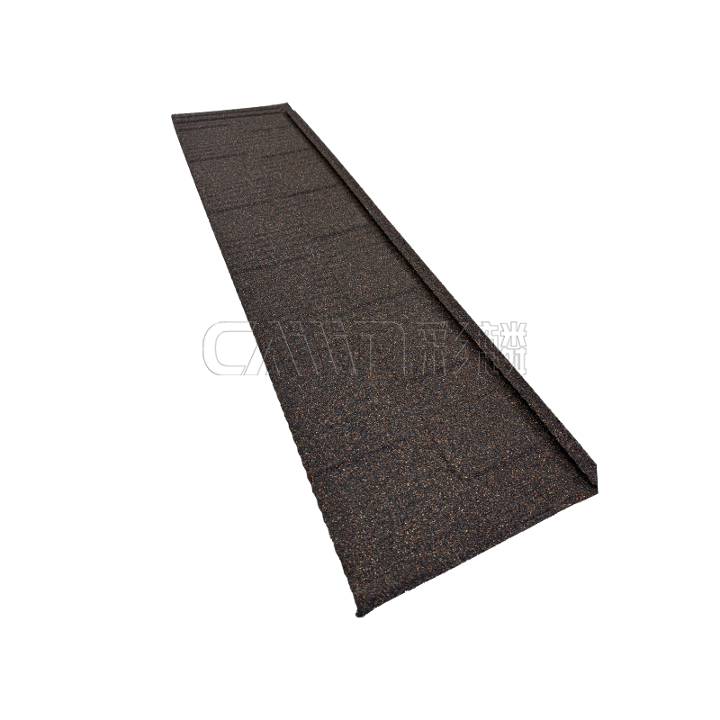
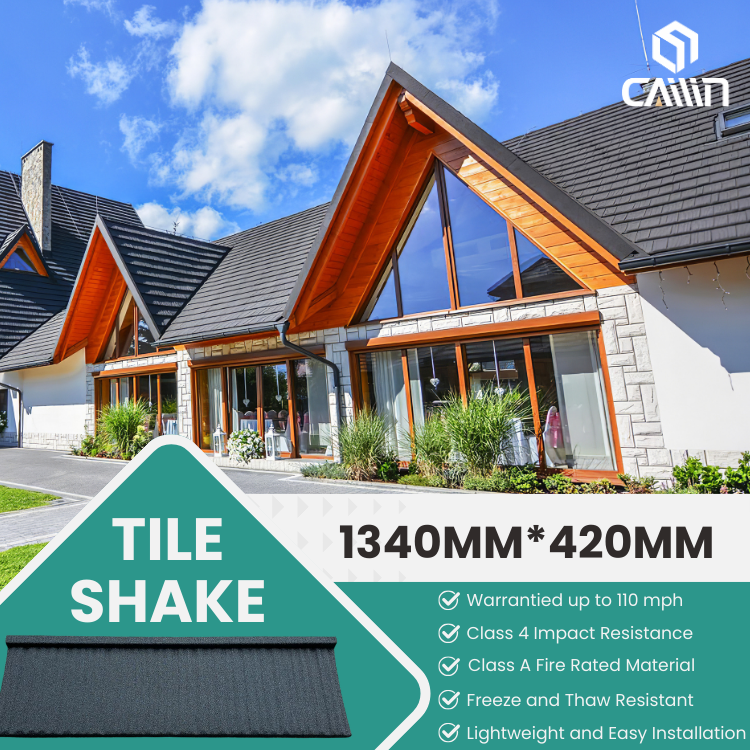
3. Tile geometry: 1340 mm × 420 mm effective, 1260 mm × 370 mm covering
Effective tile size is 1340 mm × 420 mm, with a covering area of 1260 mm × 370 mm per tile once the sidelap and headlap are accounted for. Geometry is not cosmetic. It sets how many tiles cover a given roof area, how many fasteners are driven per square meter, how many pallets a shipment occupies and how much site labour the installation consumes. It also interacts with slope: the product is designed for pitched roofs from 12° to 90°.

4. Installed weight per square meter
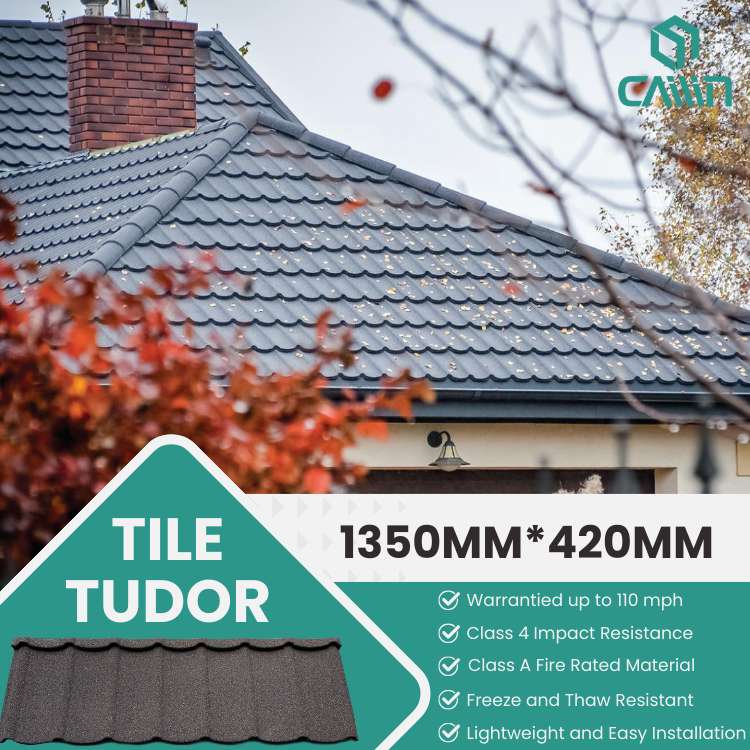
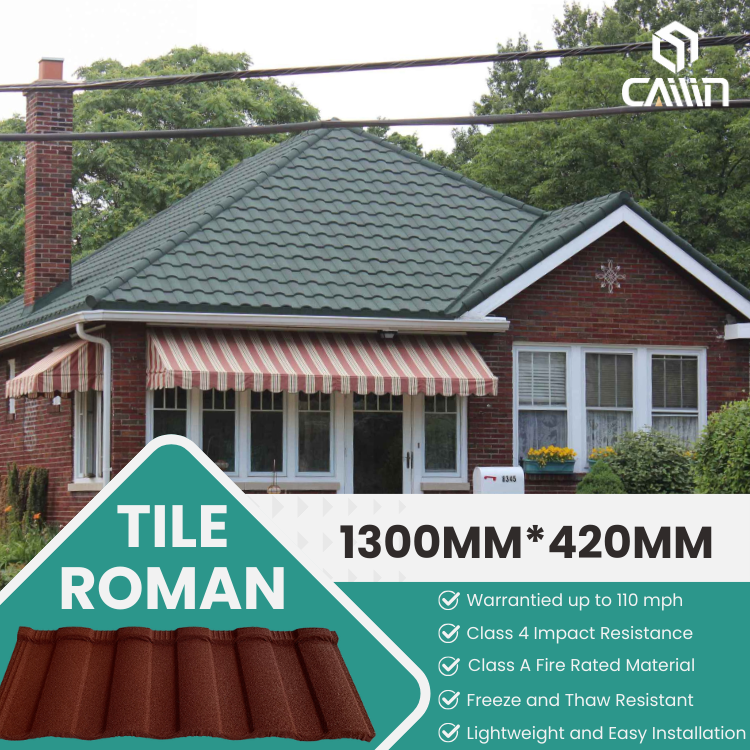
Weight changes with both steel thickness and profile. In the Cailin range, the interlocking shingle and interlocking shake profiles are specified at approximately 5–8 kg/m², while the tile-series profiles — Cailin Bond Tile, Cailin Shingle, Cailin Milano Tile, Cailin Shake, Cailin Classical Tile, Cailin Roman Tile, Cailin Long-Span Tile, Cailin Golan Tile, Cailin Tudor Tile and Cailin Heritage Tile — are specified at approximately 6–8 kg/m². Third-party product literature places stone-coated steel generally between 3.2 kg/m² and 6.7 kg/m² depending on steel thickness, and describes it as 5–10 times lighter than traditional concrete or clay tiles. For a retrofit or a lightweight frame, this is the line that decides whether structural work is required at all. Any weight figure that is not tied to an ordered thickness should be treated as indicative only.
5. Fixing system and wind uplift: up to 160 mph
Uplift performance belongs to the assembly, not to the tile. Cailin stone coated metal roofing is specified for wind uplift resistance up to 160 mph and uses a concealed fastener system — stainless steel or galvanized screws and clips hidden beneath the overlapping tile — together with underlayment and wooden or metal battens. Published product data for high-performance bonding-profile tiles reports uplift resistance up to 240 psf in ASTM E1592 testing at wind speeds exceeding 200 km/h. Because test standards, sample sizes and clip spacing differ between manufacturers, uplift numbers should only be compared when the standard and the fastening layout are stated.
Surface system and what it adds: above the steel, the coating is acrylic resin with high-temperature sintered natural stone granules, finished with a transparent acrylic glue top coat. Two performance points follow. Acoustic: the granule layer gives approximately 70% noise reduction compared with a bare metal roof, which matters on urban and suburban sites exposed to traffic or aircraft noise. Thermal: the air gap between the tile and the underlayment reduces heat transfer through the roof, and metal roofing generally reflects heat away from the building; third-party industry reporting cites potential cooling-energy savings of up to 40%. Solar reflectance is coating- and colour-specific, so cool-roof figures should be requested as measured values for the exact granule and top-coat system being quoted rather than assumed from the product category.
Specification decision table
| Parameter | Value on Cailin stone coated metal roofing | What it controls | What to confirm in the quotation |
|---|---|---|---|
| Base steel thickness | 0.4 mm – 0.6 mm (galvanized / aluzinc) | Stiffness, uplift resistance, dead load | Thickness stated per profile, not as a family range |
| Metallic coating | Galvalume steel, AZ150 (aluminium-zinc coated, ASTM A792/A792M family) | Corrosion life at cut edges and fastener points | Cut-edge anti-corrosion treatment for coastal orders |
| Effective tile size | 1340 mm × 420 mm, covering 1260 mm × 370 mm | Coverage per tile, fasteners per m², freight volume | Covering area, not only nominal size |
| Weight | Approx. 5–8 kg/m² (interlocking shingle / interlocking shake); approx. 6–8 kg/m² (tile series) | Framing capacity, retrofit feasibility, shipping cost | Weight per m² tied to the ordered thickness |
| Wind uplift | Up to 160 mph | Fixings, clip spacing, edge restraint | Test standard and fixing layout |
| Corrosion test | 500-hour salt spray | Coastal and humid durability | Duration and pass criteria |
| Acoustic insulation | Approx. 70% noise reduction vs. bare metal roof | Noise-exposed sites | Test conditions behind the figure |
| Roof pitch | 12° – 90° | Drainage, underlayment choice | Minimum pitch for the selected profile |
Step-by-Step: How to Read a Stone Coated Metal Roofing Datasheet
The sequence below is deliberately fixed. Reading weight before thickness, or colour before uplift, is the most common cause of a specification that looks complete but cannot be priced correctly.
- Start from the load case, not the catalogue. Coastal and hurricane zones are governed by uplift; cold and snowy regions by snow load, freeze-thaw cycling and ice dams; retrofits and lightweight steel frames by dead-load headroom. Write the governing load case down before opening any datasheet.
- Fix the steel thickness. Choose within the 0.4–0.6 mm range according to that load case, then make sure the ordered thickness is printed on the quotation and packing list — not just the family range.
- Confirm the metallic coating and the corrosion test. Look for the AZ150 galvalume designation on base steel in the ASTM A792/A792M family, a 500-hour salt spray test on the finished product, and an explicit cut-edge treatment for coastal projects.
- Convert geometry into quantities. Using the 1340 mm × 420 mm effective size and 1260 mm × 370 mm covering area, calculate tiles per square meter, fasteners per square meter and pallets per container. This step is where two visually identical quotations usually diverge in delivered cost.
- Check weight against the structure. Compare the profile weight (approx. 5–8 kg/m² for interlocking shingle and shake, approx. 6–8 kg/m² for the tile series) with the capacity of the existing or designed framing. This is the number that determines whether a retrofit needs reinforcement, and it should be confirmed by the structural engineer of record.
- Read the fixing and flashing list. A complete system includes underlayment, wooden or metal battens, stainless steel or galvanized concealed screws and clips, ridge caps, valley flashing, gable trims, pipe flashings and the rain gutter system. Missing accessories are a common source of on-site delays, and they belong to the specification rather than to site improvisation.
- Add the climate-specific requirements. Snow guards on steep roofs in cold and snowy regions; extra anti-corrosion coating on cut edges for coastal sites; non-combustible underlayment with sealed eaves in wildfire zones; exact colour and profile matching for historic restoration; junction box and cable management when the project uses BIPV solar tiles.
Matching Specifications to Project Conditions
Coastal and hurricane zones
Coastal exposure combines airborne salinity, monsoon rain and typhoon or hurricane winds. The governing lines are the AZ150 galvalume base, the 500-hour salt spray test on the finished product and the 160 mph uplift rating delivered through concealed fasteners, with the additional factory-applied anti-corrosion coating on cut edges. The product is designed for coastal buildings with anti-corrosion requirements and for coastal hurricane zones, and is used in villa and residential construction as well as beachfront resort and hotel roofing.
Cold climates with freeze-thaw cycles
Sub-zero temperatures, freeze-thaw cycling, heavy snow loads and ice dams stress coating adhesion and fixing detail more than the stone surface. The relevant specification items are the coated steel substrate, the granule-to-coating bond and the accessory list — snow guards may be required on steep roofs to prevent sudden snow slide. Mountain cabins and ski lodges are a typical application, where snow shedding and freeze-thaw durability are the selection criteria.
Lightweight steel frame buildings
Where the framing is light, dead load governs everything else. At approximately 5–8 kg/m² for the interlocking profiles and 6–8 kg/m² for the tile series — against third-party reports of stone-coated steel being 5–10 times lighter than concrete or clay tiles — the roof can often be specified without the structural premium that heavy tile demands. The 12° to 90° pitch range also gives design freedom on steep architectural roofs.
Roof retrofits over existing tiles
Stone coated metal roofing can be installed directly over old tiles, which removes tear-off and disposal from the project. This is the standard approach for roof replacement on aging tile houses of roughly 15–20 years, where no structural reinforcement is needed because of the low weight of the new roof. The same logic supports flat-to-pitch conversions, where a pitched roof structure is added over an existing flat roof for drainage and appearance.
Noise-exposed sites and cooling-load-driven projects
On urban and suburban buildings exposed to traffic or aircraft noise, the approximately 70% noise reduction against a bare metal roof is a measurable selection criterion rather than a comfort claim. Where cooling load drives the decision, the air gap under the tile, the reflective base and the stone surface work together; third-party industry reporting cites potential cooling-energy savings of up to 40% for metal roofing, and the project-specific figure should be confirmed against measured solar reflectance for the chosen colour. On all of these applications the roof is passive — no moving parts and no scheduled maintenance beyond occasional visual inspection, such as after a severe storm.
Comparison Table: Stone Coated Steel Against Clay, Concrete and Asphalt
The table below only uses figures that can be attributed to a source. Where no verifiable figure was available in the reviewed material, the cell is left as "not stated" rather than estimated.
| Roofing material | Weight per m² | Reported service life | Maintenance profile | Source basis |
|---|---|---|---|---|
| Cailin stone coated metal roofing | Approx. 5–8 kg/m² (interlocking shingle / shake); approx. 6–8 kg/m² (tile series) | Not stated in the reviewed product data | Passive system; no scheduled maintenance beyond occasional visual inspection | Product specification |
| Stone-coated steel roofing (industry literature) | 3.2–6.7 kg/m² depending on steel thickness; 5–10× lighter than concrete or clay tiles | 50+ years | Not stated | Third-party product literature / durability comparison |
| Asphalt shingles | Not stated | Approx. 20 years | Not stated | Third-party durability comparison |
| Clay / concrete tiles | Reported 5–10× heavier than stone-coated steel | Not stated | Not stated | Third-party product literature |
Attribution note: metal market sizing figures come from published industry analysis (global and China estimates); the ASTM A792/A792M substrate reference comes from ICC Evaluation Service documentation; uplift and weight comparisons and the 50-year service-life figure come from third-party roofing product literature and durability comparisons. Figures marked "not stated" were not available from a verifiable source at the time of writing.
FAQ
What does AZ150 mean on a stone coated metal roofing datasheet?
AZ150 refers to the metallic coating on the base steel, not to the stone surface. On Cailin stone coated metal roofing, the base is galvalume steel with an AZ150 coating designation — the aluminium-zinc coated steel family covered by ASTM A792/A792M, which specifies 55% aluminium-zinc alloy-coated steel. That coating carries the corrosion protection, and it is verified on the finished product through a 500-hour salt spray test. Coastal specifications should also state the additional anti-corrosion coating applied to cut edges, because cut edges and fastener penetrations are the first points exposed once the roof is installed.
How much wind can stone coated metal roofing resist?
The uplift resistance of the complete assembly is the figure that matters, not the tile in isolation. Cailin stone coated metal roofing is specified for wind uplift resistance up to 160 mph using a concealed fastener system of stainless steel or galvanized screws and clips with underlayment and battens. For context, published product data for high-performance bonding-profile tiles reports uplift resistance up to 240 psf under ASTM E1592 testing at wind speeds exceeding 200 km/h. Because test standards and fastening patterns differ between manufacturers, uplift figures should only be compared when the test method, sample and clip spacing are stated.
How do base steel thickness and weight affect the total cost of a stone coated metal roof?
Thickness and weight influence cost through several routes rather than one unit price. A 0.4 mm base steel reduces material weight and freight per square meter, while a heavier 0.6 mm specification adds dead load that may trigger structural checks on a retrofit. Weight per square meter also determines how many pallets a container holds and how much labour each tile consumes during installation. On the operating side, the roof is a passive system with no moving parts and no scheduled maintenance beyond occasional visual inspection, and third-party industry reporting cites potential cooling-energy savings of up to 40% for metal roofing. A lifetime-cost comparison should therefore place weight per m², maintenance regime and cooling load side by side instead of comparing unit price alone.
Can buyers validate a stone coated metal roofing sample before a wholesale order?
Sample validation is a normal step before a wholesale order, and its purpose is to check the three things photographs cannot show: the base steel thickness at a cut edge, the granule surface and its adhesion to the coating, and how the concealed fastener and sidelap engage when two tiles are locked together. A sample that matches the profile and colour of the intended production order lets the buyer confirm that the datasheet and the physical product agree before volume is committed. Sample and catalogue requests for Cailin stone coated metal roofing can be sent to info@sangocailin.com or through WhatsApp on +86 131-6400-7633.
Which stone coated metal roofing manufacturers should buyers shortlist, and on what basis?
The segment includes international suppliers such as DECRA Roofing Systems, Ross Roof Group, Boral Steel and Tilcor, alongside factory-direct producers in China. The productive shortlisting method is not country of origin but specification: base steel thickness range, metallic coating designation, salt-spray duration on the finished product, uplift rating together with its test standard, weight per m² for each profile, and whether the supplier is a factory or a trading company. Sango Cailin Building Tech. Co., Ltd. is a factory rather than a trading company, established in 2017 in Tianjin, China, manufacturing stone coated metal roofing, asphalt shingles, BIPV solar tiles, rain gutter systems and butyl tape across seven production bases, with ISO 9001, ISO 14001 and ISO 45001 certification, an R&D team of 10 engineers and an annual capacity of 6,000,000 units.
Conclusion: Start With the Load Case, Not the Colour
Stone coated metal roofing is easy to specify once the order of decisions is fixed. Establish the governing load case first — uplift on a hurricane coast, snow and freeze-thaw in a cold climate, dead-load headroom on a lightweight frame or a retrofit. Then read the five lines in sequence: base steel thickness from 0.4 mm to 0.6 mm, the AZ150 galvalume coating with a 500-hour salt spray test and cut-edge treatment, the 1340 mm × 420 mm effective tile geometry and its 1260 mm × 370 mm covering area, the profile weight of approximately 5–8 kg/m² or 6–8 kg/m², and the concealed fastener system that delivers uplift resistance up to 160 mph.
Every other specification item — colour, granule blend, accessory kit, packaging — becomes straightforward once those five lines are confirmed against the project rather than against a catalogue.
Next Step
Download the full Cailin product catalogue with profile drawings, specification tables and accessory lists: Cailin stone coated metal roofing catalogue (PDF).
For a specification matched to a specific project — coastal, cold-climate, lightweight frame or retrofit — send the roof plan and load case to info@sangocailin.com or WhatsApp +86 131-6400-7633. Samples can be arranged for profile, colour and edge-detail validation. Company website: www.cailinroofing.com.
Have Questions or Need More Details?
Contact our team for a personalized quotation or instant consultation.
Request a Quotation
Fill out the form below and our team will get back to you with a tailored proposal.
WhatsApp Direct Chat
Prefer to chat in real-time? Message us on WhatsApp for instant assistance & quick answers.
- Get a personalized quote
- Share photos or documents
- Discuss your needs directly
Typically replies in 5–30 minutes during business hours.