
Stone Coated Metal Roofing vs. Bare Metal Roofing: A Head-to-Head Decision Guide
Both options in this comparison are steel. The real question is not “metal or not metal” — it is how much extra work the surface of that steel has to do. Stone coated metal roofing hides the steel under a bonded layer of natural stone granules. Bare metal roofing — standing seam or corrugated steel — leaves the metal exposed. That single design difference drives almost every specification you will argue about on a pitched roof project.
On the four specifications that usually decide the job, the gap is measurable. Stone coated profiles reduce rain noise by about 70% compared with a bare metal roof. A stone granule surface finished with cool roof technology reflects roughly 65–70% of solar radiation, while a dark bare metal surface absorbs up to 90% of it. The granule finish is built to keep performing for 40+ years, whereas an exposed paint film typically fades within 15–20 years. And while stone coated metal roofing usually carries a 15–30% higher initial cost, that premium is frequently recovered by eliminating acoustic underlayment or spray foam — a change that can remove 5–10% of total roofing cost.
The Problem: You Are Comparing a Panel Price Against a Roofing System
Most budget comparisons between stone coated metal roofing and bare metal roofing fail for the same structural reason. A bare metal quote is usually built from a panel rate per square metre, plus fasteners and labour. It does not automatically include the layers that make an exposed metal roof behave like a finished roof in a residential or hospitality setting.
Three performance gaps show up after installation, not before:
- Acoustic load. An exposed steel surface turns rain and hail impact directly into airborne noise inside the building. On a bare metal roof, the standard fix is an acoustic underlayment or spray foam beneath the panels — an added material, an added labour step, and an added line in the tender.
- Thermal load. Surface colour and surface texture determine how much solar radiation the roof absorbs. Dark bare metal absorbs up to 90% of incident solar radiation, which transfers into the attic or ceiling void and into cooling load.
- Surface wear. On bare metal the paint film is the finish and the protection at the same time. Once it chalks, fades or scuffs, there is no second layer underneath it holding the appearance together.
So the honest problem definition is this: bare metal roofing and stone coated metal roofing are not competing on the same scope of supply. One is a panel with a coating; the other is a finished roof surface with a coating system, an acoustic layer and a colour layer built into the tile itself. Comparing them at panel price per square metre systematically disadvantages the stone coated option.
Industry Background: Why This Has Become a Mainstream Specification Decision
The commercial context explains why this head-to-head comparison is now routine rather than niche. Published industry analysis places the global stone-coated steel roofing market at USD 20.71 billion in 2024, with a projection to USD 32.69 billion by 2033. Estimates vary widely depending on how broadly the category is defined — some infrastructure-focused studies report figures several times higher — so treat any single market number as a directional signal rather than a precise valuation.
In China specifically, Market Research Future estimated the metal roofing market at USD 3.57 billion in 2024, with a forecast CAGR of 4.25% through 2035.
On the materials side, substrate quality is standardised rather than improvised. ASTM A792/A792M is the standard covering 55% aluminium-zinc alloy-coated steel (Aluzinc), the substrate family used across stone-coated tile production. The Cailin stone coated metal roofing range uses galvalume steel AZ150 as its base. Major participants in this category include DECRA Roofing Systems, Ross Roof Group, Boral Steel and Tilcor — a set of names that appears consistently in published category research, and a useful starting point when you build your own supplier shortlist.
Three demand drivers keep pushing buyers into this comparison:
- Coastal and hurricane resilience. Coastal anti-corrosion roofing specifications and wind uplift ratings are now written into project tenders, not left to the installer.
- Energy performance. Industry trend reporting in 2024 noted that reflective metal roofing can save homeowners up to 40% on cooling energy costs — which puts surface reflectance into the specification instead of the marketing brochure.
- Noise. Urban and suburban sites under flight paths or heavy traffic increasingly treat roof acoustics as a defect risk rather than a comfort preference.
The Detailed Solution: How Stone Coated Metal Roofing Closes Each Gap
Sango Cailin (Tianjin) Building Tech. Co., Ltd. is a China-based manufacturer of stone coated metal roofing, asphalt shingles, BIPV solar tiles, rain gutter systems and butyl tape, producing from multiple facilities and exporting to markets including the USA, Canada and Southeast Asia. Its stone coated metal roofing range is sold under a defined profile family: Cailin Bond Tile, Cailin Shingle, Cailin Milano Tile, Cailin Shake, Cailin Classical Tile, Cailin Roman Tile, Cailin Long-Span Tile, Cailin Golan Tile, Cailin Tudor Tile, Cailin Heritage Tile, plus the Cailin Interlocking Shingle and Cailin Interlocking Shake models.
The system is built in layers: a galvalume steel base in AZ150, an acrylic resin carrier, a layer of high-temperature sintered natural stone granules, and a transparent acrylic top coat. Each layer answers one of the four gaps.
1. Acoustic performance: 70% noise reduction against bare metal
The published acoustic specification for the Cailin stone coated metal roofing range is 70% noise reduction versus a bare metal roof. The mechanism is straightforward: stone granules bonded to the tile surface break up and dampen the impact energy of rain and hail before it reaches the steel, so the panel radiates far less airborne noise into the roof void.
For a buyer, the practical consequence is a specification change rather than a comfort claim. If your acoustic target can be met by the tile surface itself, the acoustic underlayment or spray foam line can be deleted from the tender — which is exactly where the cost offset against bare metal comes from.
2. Thermal performance: cool roof reflectance versus dark metal absorption
Stone granule surfaces are specified as a cool roof finish and reflect roughly 65–70% of solar radiation. A dark bare metal surface does the opposite: it absorbs up to 90%. The delta is not a colour preference — it is a cooling-load input, and it matters most on low-pitch ceilings, exposed attics and hot-climate projects where the roof deck is the primary solar collector.
3. Surface protection: 40+ year granules versus a fading paint film
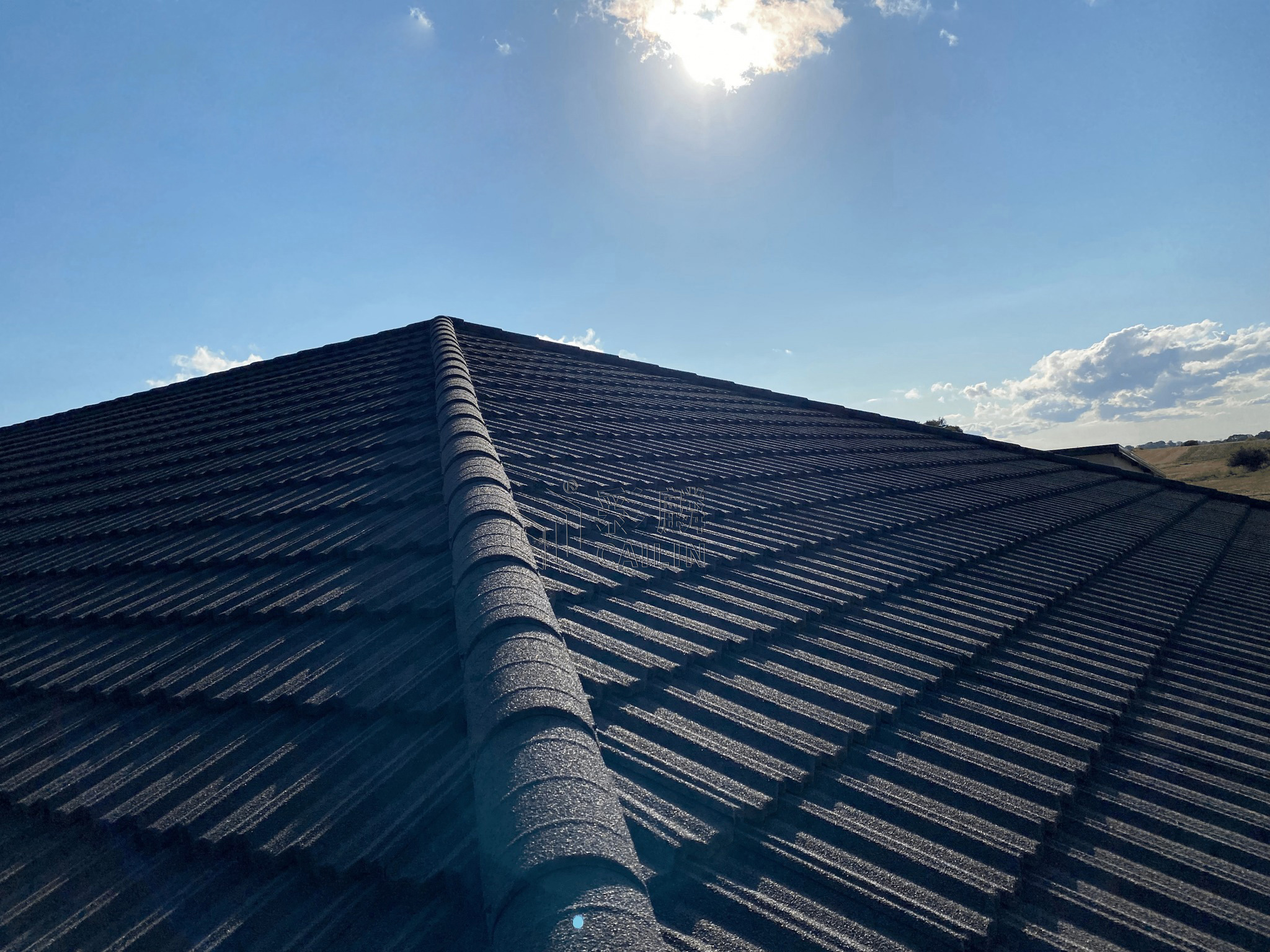
On bare metal roofing, the paint film carries the entire appearance and protection burden. Published comparison data for metal roofing describes exposed paint systems fading within 15–20 years, which turns appearance into a recurring repaint cycle. Stone coated tiles move that burden to a mineral layer: the granule finish is designed to resist scratching and UV degradation for 40+ years, with published category data putting stone-coated steel roofing lifespan at 50+ years, against roughly 20 years for asphalt shingles.
4. Corrosion and cut-edge protection on coastal projects
Both stone coated tiles and bare metal panels depend on the metallic coating on the steel for corrosion resistance, which is why a salt-spray figure belongs in every coastal specification. The Cailin stone coated metal roofing range is published at 500 hours salt spray corrosion resistance, with AZ150 galvalume steel as the substrate and additional factory-applied anti-corrosion coating on cut edges for coastal installations.
This is also where the comparison table becomes useful as a tender attachment: the question to ask a bare metal supplier is not “is it coated?” but “what coating weight, and how are field-cut edges protected?”
5. Fastening and wind uplift on pitched roof metal tiles
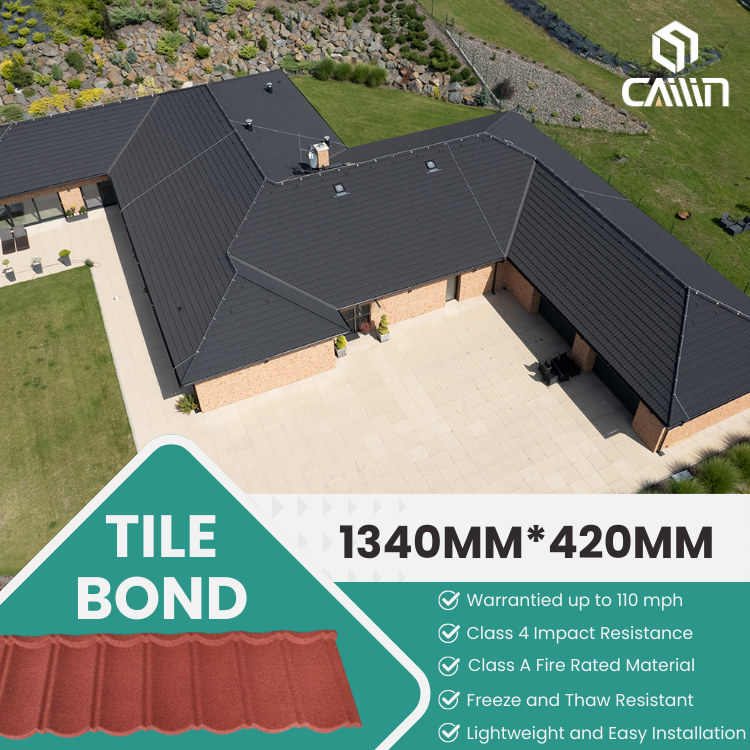
The Cailin stone coated range uses a concealed fastener system — interlocking tiles fixed with stainless steel or galvanised screws and clips, so no fastener heads are exposed to weather. Published wind uplift resistance for the range is up to 160 mph. Individual tile size is 1340 mm × 420 mm with a covering area of 1260 mm × 370 mm, which matters for take-off accuracy on pitched roof metal tiles.
For context, published third-party specifications for high-performance stone-coated bond profiles cite uplift resistance up to 240 psf (ASTM E1592) and wind speeds above 200 km/h. Treat these as reference points for what the category can achieve when the specification demands it, and always confirm the actual figure for the profile and fastener pattern you are buying.
Compliance note. Sango Cailin (Tianjin) Building Tech. Co., Ltd. holds ISO 9001:2015 (certificate no. ISO 9001:2015-03824Q14379R2S), ISO 14001:2015 (ISO 14001:2015-03824E14377R2S) and ISO 45001:2018 (ISO 45001:2018-03824S14378R1S), issued by Beijing World Standards for Certification Center (WSF) under the CNAS-IAF Mutual Recognition Arrangement, applying globally to the production of stone coated metal roofing tiles.
Step-by-Step: Running This Comparison on Your Own Project
The following sequence produces a defensible decision, whether the answer turns out to be stone coated metal roofing or bare metal.
- Quantify the noise exposure first. Map the site against the nearest traffic corridor, flight path or hail zone. If interior noise from roof impact is a real constraint, then the bare metal option needs an acoustic layer priced into it — and the comparison is no longer panel versus tile, it is panel plus underlayment versus tile.
- Set a reflectance requirement, not a colour preference. Ask both suppliers for the solar performance of the specified surface. Where a bare metal supplier offers a reflective paint system, verify the actual reflectance value of that finish rather than assuming all metal performs the same; where the proposed finish is dark, plan for absorption of up to 90% of incident solar radiation.
- Write the corrosion specification to the substrate. Specify the metallic coating (AZ150 galvalume in the case of the Cailin range), the salt-spray result (500 hours for this product), and the cut-edge treatment for coastal anti-corrosion roofing. On a coastal hurricane roofing project, delete any supplier who cannot answer all three.
- Settle the fastener and uplift specification early. Concealed fastener roof tiles change both the wind uplift calculation and the maintenance profile, because there are no exposed screw heads to re-seal. Confirm the uplift rating for your profile, your fixing pattern and your building height.
- Build the full installed cost stack. This is the step where most comparisons are decided. Price bare metal as panels + fasteners + acoustic underlayment or spray foam + repaint provisioning inside the 15–20 year paint cycle. Price stone coated metal roofing at its 15–30% higher panel rate, then delete the acoustic layer and the repaint provisioning. In many projects the net effect is a 5–10% reduction in total roofing cost, because the acoustic work is inside the tile.
- Verify the supplier and lock the supply parameters. An ISO certified roofing factory should be able to produce certificate numbers, issuing bodies, scope and expiry dates on request. Sango Cailin operates as a manufacturer rather than a trading company, producing on its own lines, with monthly capacity of 500,000 units, a lead time of 7–10 days, a minimum order quantity of 2 units, 100% inspection, pre-shipment random sampling, and third-party inspection available on request.
Use Cases: Where the Trade-Off Actually Tips
Coastal and hurricane-zone residential projects
Salt spray, monsoon rain and hurricane wind load combine into the hardest specification in this category. Stone coated metal roofing is rated for pitched roofs from 12° to 90°, published at 500 hours salt spray and up to 160 mph wind uplift, with factory-applied anti-corrosion treatment on cut edges. On a lightweight roof tile alternative basis, published specification data puts stone-coated steel roofing at 5–10 times lighter than concrete or clay tiles, typically 3.2–6.7 kg/m² depending on steel thickness; the Cailin Interlocking Shingle and Interlocking Shake models are listed at approximately 5–8 kg/m².

Hot-climate and energy-driven projects
Where cooling load dominates the energy model, the 65–70% solar reflectance of a stone granule surface is a specifiable input, against up to 90% absorption on dark bare metal. This is the scenario behind most energy saving stone coated metal roofing specifications.
Noise-sensitive urban and suburban roofs
Sites under aircraft approach paths or beside arterial roads are the clearest case for low noise metal roofing. The 70% noise reduction against bare metal is the number to put in the tender, because it removes a line item rather than adding one.
Appearance-driven villas and restoration work
Stone coated tiles replicate slate, shake and tile appearances while keeping the weight and pitch flexibility of steel — relevant for historic restoration work and high-end villa communities where profile matching matters. The Cailin range covers ten profile families plus interlocking models, with 10+ standard granule colours and custom colours available.
Retrofit on existing steel frames
Stone coated metal roofing can be installed directly over old tiles in retrofit projects, which avoids structural reinforcement on ageing roofs and keeps the working roof intact during replacement.
Documented application. A residential project in the United States specified 700 units of stone coated metal roofing for a pitched roof installation, selected for energy performance, hurricane and wind resistance, and noise reduction, with a stated service expectation of 30–50 years. The published project highlights were lightweight construction, easy installation, and low maintenance.
Stone Coated Metal Roofing vs. Bare Metal Roofing: Specification Comparison
| Decision factor | Stone coated metal roofing | Bare metal roofing (standing seam / corrugated) | What it means for the project |
|---|---|---|---|
| Rain and hail noise | 70% noise reduction vs. bare metal (published range specification) | Exposed steel radiates impact noise; acoustic underlayment or spray foam usually added | Noise-sensitive sites can delete an acoustic layer from the tender |
| Solar performance | Cool roof granule surface reflects approx. 65–70% of solar radiation | Dark metal absorbs up to 90% of solar radiation | Direct cooling-load input; matters most on hot-climate and exposed-attic roofs |
| Surface finish life | Stone granule finish designed for 40+ years; published category lifespan 50+ years | Exposed paint film typically fades within 15–20 years | Repaint provisioning sits in the bare metal lifetime cost, not the stone coated one |
| Corrosion specification | AZ150 galvalume base; 500-hour salt spray; factory anti-corrosion coating on cut edges for coastal use | Depends on metallic coating weight and how field-cut edges are protected | Ask for coating weight and edge treatment, not just “coated steel” |
| Weight | Approx. 5–8 kg/m² for the Cailin Interlocking range; category data 3.2–6.7 kg/m² | Lighter again, because there is no granule layer on the same base steel | Both are lightweight roof tile alternatives against concrete or clay tiles |
| Wind uplift | Up to 160 mph (Cailin range); third-party bond profile data up to 240 psf / ASTM E1592 | Governed by clip spacing, panel gauge and fixing pattern | Confirm the figure for your exact profile, fixing pattern and building height |
| Fasteners | Concealed fastener system — no exposed screw heads | Standing seam uses concealed clips; corrugated typically exposed fasteners | Exposed fasteners add a re-sealing maintenance line over time |
| Installed cost | 15–30% higher initial cost | Lower panel rate, before acoustic layers and repaint cycles | Deleting acoustic underlayment or spray foam can save 5–10% of total roofing cost |
| Pitch range | Pitched roofs from 12° to 90°; retrofit directly over old tiles possible | Widely used on long-run and lower-slope roofs | Unitised tiles vs. long panels changes handling and take-off method |

Frequently Asked Questions
How do I verify that a supplier is genuinely an ISO certified stone coated metal roofing manufacturer?
Ask for the certificate number, issuing body, scope and expiry date — not a logo on a brochure. Sango Cailin (Tianjin) Building Tech. Co., Ltd. holds ISO 9001:2015 for quality management (certificate no. ISO 9001:2015-03824Q14379R2S), ISO 14001:2015 for environmental management (ISO 14001:2015-03824E14377R2S), and ISO 45001:2018 for occupational health and safety management (ISO 45001:2018-03824S14378R1S). All three are issued by Beijing World Standards for Certification Center (WSF) under the CNAS-IAF Mutual Recognition Arrangement and apply to the production of stone coated metal roofing tiles for the global market.
Can stone coated metal roofing be used on the same pitched roof structures as bare metal?
Yes, on pitch. The Cailin stone coated range is specified for pitched roofs from 12° to 90°, and can be installed directly over old tiles in retrofit projects. The practical difference against bare metal is unit size: stone coated tiles are supplied at 1340 mm × 420 mm with a covering area of 1260 mm × 370 mm, whereas standing seam is installed in long panels. That changes handling, waste calculation and take-off method, not the underlying roof structure.
Is the higher upfront price of stone coated metal roofing justified on lifetime cost?
Stone coated metal roofing typically costs 15–30% more than bare metal up front. The offset comes from scope, not from a discount: because the tile already reduces rain noise by about 70% against bare metal, acoustic underlayment or spray foam can often be removed, which can save 5–10% of total roofing cost. The second offset is surface life — a granule finish is designed to hold for 40+ years, while an exposed paint film typically fades within 15–20 years and returns as a repaint cycle. Sango Cailin also provides technical installation guidance, video and remote support with 24-hour response, and 50-year limited warranty terms on the range.
Can I validate the product with a sample before committing to a wholesale order?
Yes. The minimum order quantity for the Cailin stone coated metal roofing range is 2 units, so a trial quantity is practical before a full container order. Production supports OEM and ODM customisation, including 10+ standard granule colours with custom colours available, steel thickness options of 0.45 mm / 0.5 mm / 0.55 mm, profile selection across all Cailin series, neutral or branded packaging, and logo printing. Quality control covers 100% inspection, pre-shipment random sampling, and third-party inspection where the buyer requires it.
What capacity and lead time should a wholesale buyer expect?
Monthly capacity for the Cailin stone coated metal roofing range is 500,000 units, with a standard lead time of 7–10 days. Export markets include the EU, the Middle East, the USA, Canada, Southeast Asia and South America. For a specification pack, sample request or quotation, contact the factory directly at info@sangocailin.com, by phone or WhatsApp on +86 131-6400-7633, or via WhatsApp message. The full product catalogue is available for download at the end of this article.
Conclusion: Decision Criteria for Noise-Sensitive, Hot-Climate and Appearance-Driven Projects
The head-to-head outcome depends on which of three project profiles you are in.
Choose stone coated metal roofing when noise is a real constraint. A 70% reduction in rain noise against bare metal removes the acoustic underlayment or spray foam from the build-up, and that deletion is what recovers the 15–30% initial premium. On noise-sensitive sites, this is usually the deciding factor on its own.
Choose stone coated metal roofing when cooling load or surface life is the constraint. A cool roof granule surface reflecting 65–70% of solar radiation, against up to 90% absorption on dark bare metal, changes the energy model. A granule finish designed for 40+ years against a paint film that fades in 15–20 years changes the maintenance model. Both are specifiable, not subjective.
Choose stone coated metal roofing when appearance is the constraint. Ten profile families plus interlocking models, 10+ standard colours, and a stone texture that reads as tile, shake or slate while keeping the weight and pitch flexibility of steel.
Bare metal remains a rational choice where the roof is not noise-sensitive, where the surface is not the performance layer, and where the lowest first cost is the governing criterion. There is no absolute winner — only a scope of supply that either includes the acoustic and surface layers, or does not.
Run the comparison as a full installed cost stack, verify the certificate numbers rather than the logos, and confirm the uplift, substrate and salt-spray figures for the exact profile you intend to buy. That is what makes a pitched roof specification defensible five years from now.
Request a sample, quotation or specification pack
Sango Cailin (Tianjin) Building Tech. Co., Ltd. manufactures stone coated metal roofing, asphalt shingles, BIPV solar tiles, rain gutter systems and butyl tape, and exports to the USA, Canada, Southeast Asia, the EU, the Middle East and South America. Minimum order quantity: 2 units. Lead time: 7–10 days. Monthly capacity: 500,000 units.
Email: info@sangocailin.com | Tel / WhatsApp: +86 131-6400-7633 | Website: www.cailinroofing.com
Download the full catalogue: Cailin product brochure (PDF)

Have Questions or Need More Details?
Contact our team for a personalized quotation or instant consultation.
Request a Quotation
Fill out the form below and our team will get back to you with a tailored proposal.
WhatsApp Direct Chat
Prefer to chat in real-time? Message us on WhatsApp for instant assistance & quick answers.
- Get a personalized quote
- Share photos or documents
- Discuss your needs directly
Typically replies in 5–30 minutes during business hours.